Peptide synthesis is a foundational process in biochemical and molecular research. While modern synthesis techniques have improved efficiency and precision, producing high-quality peptides remains a complex task. Researchers must account for several challenges that can affect yield, purity, and reproducibility.
Understanding these challenges helps researchers better interpret analytical data and maintain consistency in laboratory studies.

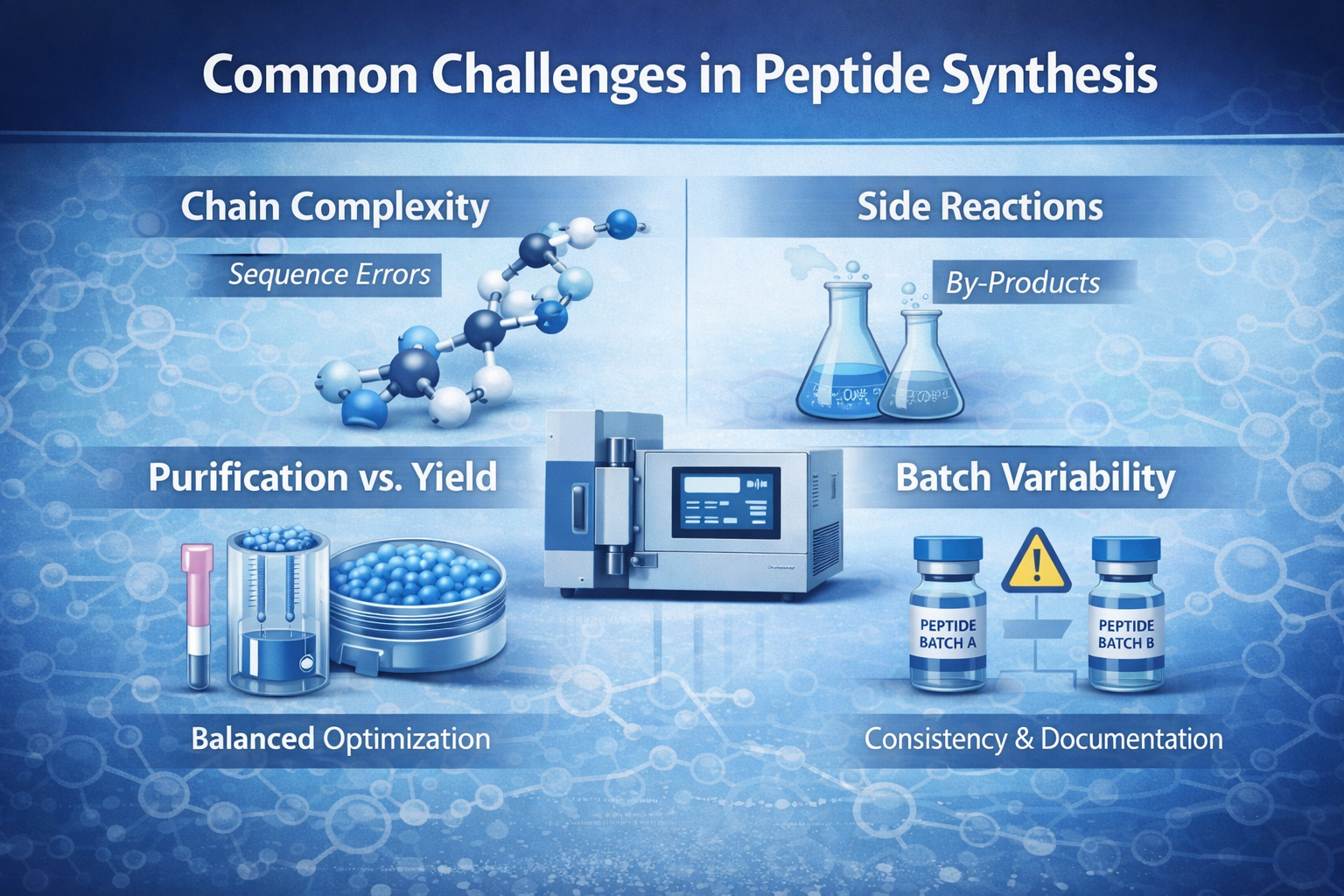
Peptides are synthesized by linking amino acids in a precise sequence. As chain length increases, the likelihood of incomplete coupling or sequence errors also rises. Even small deviations can introduce impurities or structural inconsistencies that affect downstream research.
To manage this complexity, synthesis protocols are carefully optimized and monitored at each stage to reduce errors and improve overall accuracy.
During peptide Synthesis, side reactions may occur due to chemical interactions between reagents or incomplete deprotection steps. These reactions can produce unwanted by-products that reduce purity and complicate analytical interpretation.
Researchers address this by refining reaction conditions, adjusting solvents, and implementing thorough purification processes after synthesis.
Achieving high purity often requires extensive purification, which can reduce overall yield. Balancing purity and yield is a common challenge, especially when working with longer or more complex peptide sequences.
Techniques such as preparative chromatography are used to isolate the target compound while minimizing material loss, allowing researchers to maintain both quality and efficiency.
Consistency across production batches is critical for reproducible research. Variations in synthesis conditions, raw materials, or environmental factors can introduce differences between batches.
To reduce variability, standardized protocols and quality control checks are applied throughout the synthesis process. Analytical testing ensures each batch meets defined purity and identity standards before use.
Analytical testing plays a key role in identifying synthesis challenges. Techniques such as High-Performance Liquid Chromatography and Mass Spectrometry are used to evaluate purity, detect impurities, and confirm molecular identity.
These methods allow researchers to identify issues early and refine synthesis approaches accordingly.
Accurate documentation supports transparency and traceability in research workflows. Detailed records of synthesis conditions, analytical results, and batch data help researchers maintain quality standards and support reproducibility.
Documentation also allows for informed decision-making when comparing materials across studies or experiments.
Peptide synthesis involves multiple challenges that require careful planning, monitoring, and verification. By understanding common synthesis issues and how they are addressed, researchers can better interpret analytical data and maintain consistency in scientific studies.
High-quality peptide synthesis and thorough verification remain essential components of responsible peptide research.