
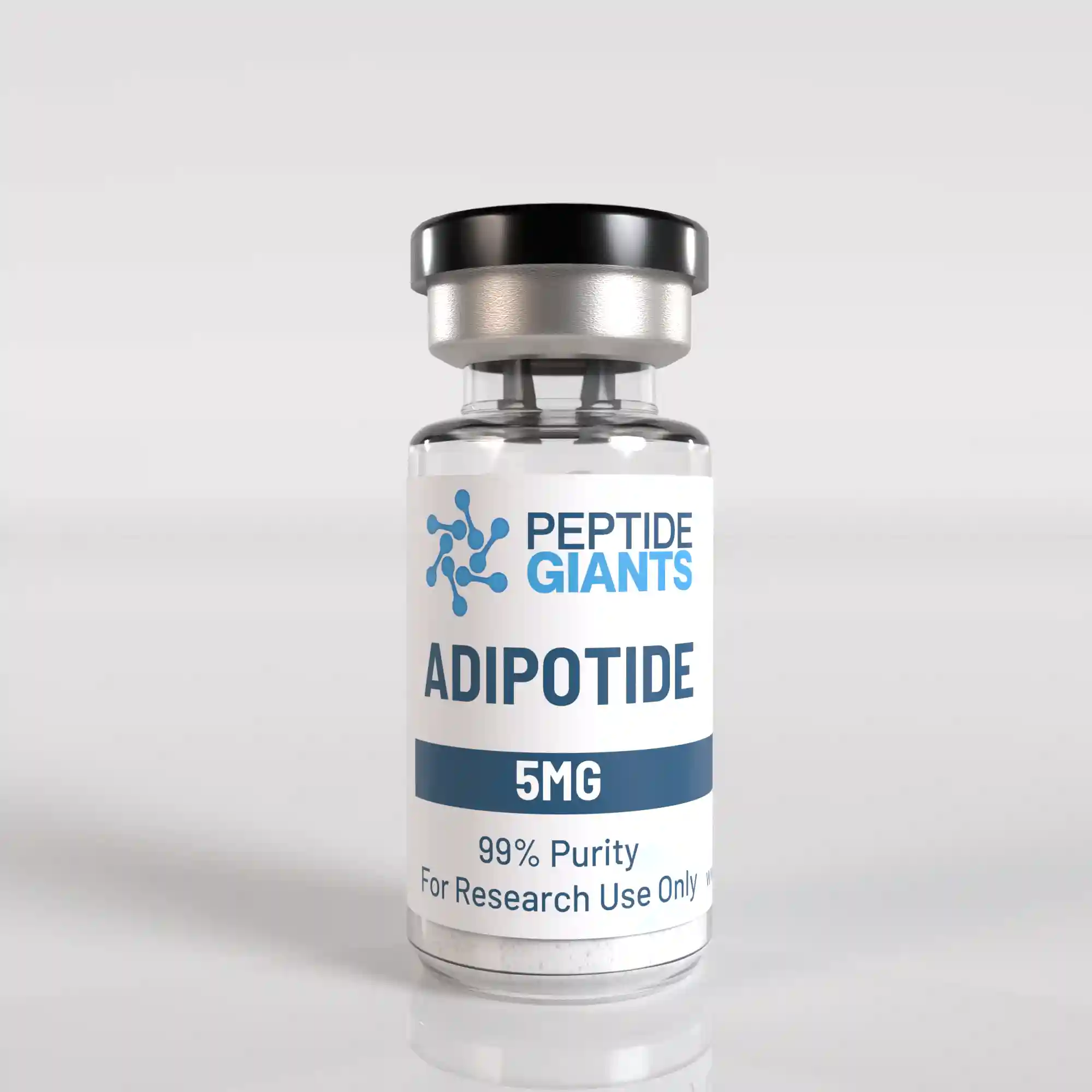
Adipotide 5mg Research Peptide
Adipotide (FTPP) is a synthetic chimeric peptidomimetic supplied as a lyophilized powder for laboratory research. The 5mg lot PG-6008 tested at 99.00% purity by HPLC. Lab report linked below.
For laboratory research use only. Not for human or veterinary use.
Test results for this batch
Product details
Frequently asked questions
Store lyophilized vials at -20°C for maximum shelf life up to 24 months. Reconstituted solutions should be refrigerated at 2°C to 8°C and used within 30 days.
Every vial is printed with a batch lot number. You can check the HPLC purity certificate for that lot in the Test Results section above.
Orders placed before 6:00 PM ET, Monday to Friday, ship the same day from our Florida warehouse with full USPS / FedEx tracking.
Best sellers
About Adipotide 5mg Research Peptide
Adipotide (FTPP, prohibitin-targeting peptide 1) is a synthetic chimeric peptidomimetic, CKGGRAKDC-GG-D(KLAKLAK)2, supplied as a lyophilized powder for laboratory research on ligand-directed targeting of white adipose tissue vasculature. Each batch is tested by an independent lab, and the real result for the batch is shown here with a link to the full lab report.
You can browse every batch report on our lab reports page. Free shipping applies on orders over $200.
Specifications
| Compound name | Adipotide, also known as FTPP and prohibitin-targeting peptide 1 |
|---|---|
| Sequence | CKGGRAKDC-GG-D(KLAKLAK)2 |
| Compound class | Synthetic chimeric peptidomimetic (homing motif plus D-amino-acid effector domain) |
| Length | 25 residues: a 9-residue homing motif, a 2-residue Gly-Gly linker and a 14-residue D-amino-acid effector domain |
| Molecular formula | C111H206N36O28S2, the reference value for the linear, reduced form with a free C-terminus[1] |
| Molecular weight | 2557.2 g/mol for that form. About 2555.2 g/mol if the two cysteines are disulfide-bridged (calculated). The lab report does not state a mass. |
| Calculated net charge, pH 7 | About +8: eight Lys, one Arg and the N-terminus, minus one Asp and the C-terminus |
| Form | Lyophilized powder |
| Vial size | 5mg |
| CAS number | 859216-15-2[1] |
| Lot number | PG-6008 |
| Identity (5mg batch) | Pass, matches reference standard by HPLC-UV/VIS |
| Purity (5mg batch) | 99.00% ± 0.18% by HPLC-UV/VIS |
| Measured content (5mg batch) | 5.23mg against 5mg labeled |
| Testing laboratory | Vanguard Laboratory, Olympia, WA (report dated 1 August 2026) |
| Storage (unopened) | -20°C, dry, protected from light |
| Intended use | In-vitro and preclinical laboratory research only |
Product details
Overview
Adipotide joins a nine-residue homing motif, CKGGRAKDC, to a D-amino-acid sequence, D(KLAKLAK)2, through a Gly-Gly linker. The two domains were designed to work as a pair: one directs the molecule to a target, and the other is the effector.
Mechanism of interest
In the original work, the CKGGRAKDC motif was found by in vivo phage display and was shown to associate with prohibitin, which was established as a vascular marker of adipose tissue. Targeting a pro-apoptotic peptide to prohibitin in the adipose vasculature ablated white fat in mice.[2] The effector domain, D(KLAKLAK)2, is the d-enantiomer of an amphipathic sequence that disrupts mitochondrial membranes after receptor-mediated internalization and causes targeted apoptosis.[3] Pro-apoptotic domains of this kind were described in 1999 as non-toxic outside cells and toxic once internalized.[4] The same two-domain approach was used with a different homing peptide to target the prostate in mice.[5] The lab report does not state whether the two cysteines of the homing motif are disulfide-bridged.
Published research context
Adipotide has been studied in obese mice and in obese rhesus monkeys. In mice, the 2004 study reported rapid reversal of obesity,[2] which a later paper summarized as about 30% weight reduction over 4 weeks.[3] In 10 treated obese rhesus monkeys, followed for 4 weeks of treatment and 4 weeks of recovery, average body weight fell 10.6%, BMI 10.0% and abdominal circumference 8.4% relative to baseline. Food intake fell and insulin resistance improved, and lean monkeys did not lose weight.[3] The monkey study also reported dose-dependent increases in serum creatinine and blood urea nitrogen and changes in renal proximal tubule function, most of which reversed within 28 days after treatment stopped.[3] These are animal findings. Our listing describes them only to help researchers find the literature, and it is not a statement about what the material does in people.
Human data
The ClinicalTrials.gov registry lists one first-in-human phase 1 study of prohibitin targeting peptide 1 in patients with metastatic prostate cancer and obesity (NCT01262664, M.D. Anderson Cancer Center). It started in May 2012, enrolled 4 participants, and is listed as terminated at the principal investigator’s request.[6] Adipotide is not an approved medicine, and this page makes no claim about its use or effects in people.
Purity and quality testing
Every batch is tested by an independent laboratory before it is listed. The result for this lot is published as the full certificate of analysis, so you can check the number yourself instead of trusting a summary. The report carries the laboratory’s ISO/IEC 17025:2017 accreditation mark and refers to A2LA Certificate #6377.01 for the list of accredited tests.
The report shows an HPLC chromatogram, an identity result against a reference standard, chromatographic purity with an uncertainty, and quantity. It does not include a mass spectrum, so this report does not confirm the molecular mass. The laboratory also notes that it did not take part in sample selection and cannot confirm that the sample represents the whole lot.
How to read the lab report
- Check the lot number and report date match your vial. The 5mg lot shown here is PG-6008.
- On the HPLC chromatogram, the main peak should dominate. The purity figure is that peak's share of the total area, reported with the lab's uncertainty.
- Compare the measured quantity with the label. For this lot the lab reported 5.23 mg against 5 mg.
- Use the verification link on the lab reports page to confirm the report on the laboratory's own site.
Form, preparation and storage
How Adipotide compares with its component sequences
Researchers sometimes work with the parts of the molecule separately, and they behave differently.
| Compound | Type | Role in published work |
|---|---|---|
| Adipotide (FTPP) | Chimeric peptidomimetic | Homing motif and effector domain joined by a Gly-Gly linker |
| CKGGRAKDC | Homing motif (nine residues) | Binds prohibitin on adipose vasculature, with no effector domain |
| D(KLAKLAK)2 | D-amino-acid effector sequence | Membrane-disrupting domain, with no targeting motif |
Together the three parts make up 25 residues: a 9-residue homing motif, a 2-residue Gly-Gly linker and a 14-residue effector domain. The effector domain is a d-enantiomer amphipathic sequence designed to disrupt mitochondrial membranes once inside a cell.[3]
Why researchers order from Peptide Giants
Reliable work depends on knowing exactly what is in the vial, and we publish the evidence for it.
Frequently asked questions about Adipotide Lyophilized Research Peptide
What is Adipotide?
Adipotide, also called prohibitin-targeting peptide 1 or FTPP, is a synthetic chimeric peptidomimetic with the sequence CKGGRAKDC-GG-D(KLAKLAK)2. It is supplied here as a lyophilized powder for in-vitro and preclinical research on ligand-directed targeting of adipose vasculature.
Is Adipotide the same as FTPP?
Yes. FTPP, prohibitin-targeting peptide 1 and Adipotide are names for the same compound, CAS 859216-15-2.[1] The trial registry record uses the name prohibitin targeting peptide 1, with the intervention name Prohibitin-TP01.[6]
What is the molecular weight and formula of Adipotide?
PubChem lists Adipotide as C111H206N36O28S2 with a molecular weight of 2557.2 g/mol.[1] By our calculation from the sequence, that formula corresponds to the linear peptide with free cysteine thiols and a free C-terminus. If the two cysteines are linked by a disulfide bond, the calculated mass is about 2 Da lower, about 2555.2 g/mol. The lab report does not state a mass or the disulfide status, so these are reference values, not measurements.
Why is Adipotide called a peptidomimetic?
The literature uses that term for this chimeric molecule, which joins a homing motif (CKGGRAKDC) to a d-enantiomer effector sequence, D(KLAKLAK)2, through a Gly-Gly linker.[3]
Has Adipotide been tested in people?
The ClinicalTrials.gov registry lists one first-in-human phase 1 study of prohibitin targeting peptide 1 in patients with metastatic prostate cancer and obesity (NCT01262664, M.D. Anderson Cancer Center). It started in May 2012, enrolled 4 participants, and is listed as terminated at the principal investigator’s request.[6] Adipotide is not an approved medicine, and this page makes no claim about its use or effects in people.
What purity is it tested at?
The 5mg batch, lot PG-6008, tested at 99.00% plus or minus 0.18% by HPLC-UV/VIS at Vanguard Laboratory, reported on 1 August 2026. You can open the report from the lab reports page. The ± 0.18% is the uncertainty the laboratory reports with the result. Chromatographic purity is the share of the main peak in the total peak area.
Why is the measured content different from the label?
The lab measures the amount of peptide actually present in the vial. For lot PG-6008 it reported 5.23 mg against the 5 mg label, which is about 4.6% above the labeled amount. We show the real figure instead of rounding it to the label.
Do you provide a certificate of analysis?
Yes. Each batch has a third-party certificate of analysis, and the one for this lot is linked on this page and on the lab reports page. It carries the lot number, the HPLC chromatogram, the identity check, the purity result and the measured quantity.
What does the certificate cover?
The report covers identity by HPLC-UV/VIS match to a reference standard, chromatographic purity and measured quantity. It does not report identity by mass spectrometry, heavy metals, microbiology or endotoxin, so arrange your own testing if your work needs those.
What is in the Adipotide sequence?
It has two parts joined by a Gly-Gly linker: the nine-residue homing motif CKGGRAKDC, and the D-amino-acid sequence D(KLAKLAK)2, which published work describes as a membrane-disrupting effector domain.
How does Adipotide work in the published research?
In the published animal work, the CKGGRAKDC motif was found by in vivo phage display and associates with prohibitin, which was established as a marker of white adipose vasculature.[2] The attached D(KLAKLAK)2 domain is an amphipathic d-enantiomer sequence that disrupts mitochondrial membranes after receptor-mediated internalization and causes targeted apoptosis.[3] This describes published preclinical research, not use in people.
What does the published animal research report?
In obese mice, the 2004 study reported rapid reversal of obesity,[2] which a later paper describes as about 30% weight reduction over 4 weeks.[3] In obese rhesus monkeys treated for 4 weeks, average body weight fell 10.6%, BMI 10.0% and abdominal circumference 8.4% relative to baseline, with reduced food intake and improved insulin resistance. Lean monkeys did not lose weight.[3] These are animal findings only.
What kidney findings were reported in the monkey study?
The monkey study reported dose-dependent increases in serum creatinine and blood urea nitrogen and changes in renal proximal tubule function. Most alterations in serum and urine reversed within 28 days after treatment stopped.[3] Researchers working with this compound should read the primary paper.
What if my order arrives damaged?
Contact us within 48 hours with your order number and photos of the vial and packaging, and we will arrange a replacement or refund under our returns policy.
Is checkout secure?
Payments are processed through encrypted payment providers, and we do not store full card details. See our privacy policy.
References
- National Center for Biotechnology Information. PubChem Compound Summary for CID 163360068, Adipotide. PubChem
- Kolonin MG, Saha PK, Chan L, Pasqualini R, Arap W. Reversal of obesity by targeted ablation of adipose tissue. Nat Med. 2004;10(6):625-632. PubMed | DOI
- Barnhart KF, Christianson DR, Hanley PW, et al. A peptidomimetic targeting white fat causes weight loss and improved insulin resistance in obese monkeys. Sci Transl Med. 2011;3(108):108ra112. PubMed | DOI | Full text
- Ellerby HM, Arap W, Ellerby LM, et al. Anti-cancer activity of targeted pro-apoptotic peptides. Nat Med. 1999;5(9):1032-1038. PubMed | DOI
- Arap W, Haedicke W, Bernasconi M, et al. Targeting the prostate for destruction through a vascular address. Proc Natl Acad Sci U S A. 2002;99(3):1527-1531. PubMed | DOI
- ClinicalTrials.gov. NCT01262664: A First-in-Man, Phase I Evaluation of A Single Cycle of Prohibitin Targeting Peptide 1 in Patients With Metastatic Prostate Cancer and Obesity. ClinicalTrials.gov
Content last reviewed 27 November 2026. Formula, mass and charge values on this page are reference or calculated values, not measurements from the lab report.
Research background
Extensively researched across peer-reviewed literature for cellular mechanisms, binding affinity, and biochemical pathways in laboratory models.
Quality and analytical standard
Each batch is tested by Vanguard Laboratory, a third-party analytical lab. Check the lot number on your vial against the test results and COA on this page.
Customer reviews
Third time ordering. Lyophilized powder reconstitutes crystal clear with zero residue. Fast domestic shipping with tracking provided right away. You can trust Peptide Giants.
Dispatched the same afternoon from Tampa and arrived on my doorstep two days later. The insulated protective packaging ensured vials were completely intact.
Reached out on WhatsApp before buying to confirm batch expiry dates. Got a friendly response within 10 minutes. Research results have been spot-on.
No customs delays since it ships straight out of Florida. Clean cakes, sterile crimps, and rapid delivery every single time.