

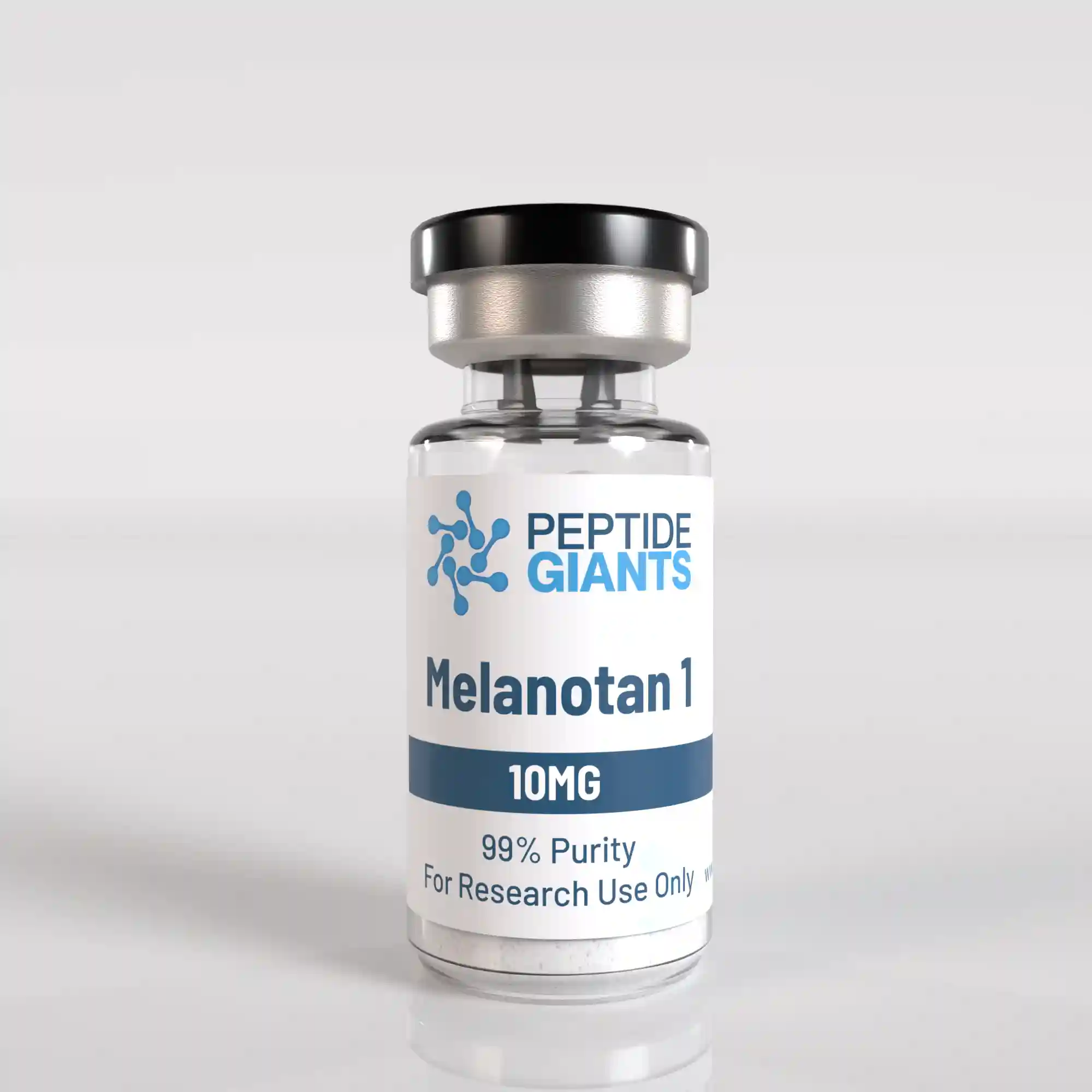
Melanotan 1 10mg
Melanotan 1 (MT-1, afamelanotide) 10 mg lyophilized research peptide, a linear 13-residue analog of α-MSH. Lot PG-6020 lab report: 99.260% ± 0.18% purity by HPLC-UV/VIS (Vanguard Laboratory, 7 Aug 2026). For laboratory research use only.
Test results for this batch
Product details
Frequently asked questions
Store lyophilized vials at -20°C for maximum shelf life up to 24 months. Reconstituted solutions should be refrigerated at 2°C to 8°C and used within 30 days.
Every vial is printed with a batch lot number. You can check the HPLC purity certificate for that lot in the Test Results section above.
Orders placed before 6:00 PM ET, Monday to Friday, ship the same day from our Florida warehouse with full USPS / FedEx tracking.
Best sellers
About Melanotan 1 10mg
Melanotan 1 (also written Melanotan I, MT-1 or afamelanotide) is a linear 13-residue synthetic analog of α-melanocyte-stimulating hormone (α-MSH), [Nle4,D-Phe7]-α-MSH, supplied here as a lyophilized powder for laboratory research in a 10 mg vial, with a batch-specific third-party lab report.
You can browse every batch report on our lab reports page. Free shipping applies on 5 or more vials or orders over $200.
Specifications
| Compound name | Melanotan 1 (Melanotan I, MT-1, afamelanotide; [Nle4,D-Phe7]-α-MSH, also written NDP-MSH)[3] |
|---|---|
| Sequence (13 residues) | Ac-Ser-Tyr-Ser-Nle-Glu-His-D-Phe-Arg-Trp-Gly-Lys-Pro-Val-NH2 (linear; N-terminal acetyl, C-terminal amide) |
| Molecular formula | C78H111N21O19[3] |
| Molecular weight | About 1646.8 g/mol (PubChem value; not measured on the lab report)[3] |
| CAS number | 75921-69-6 (listed for this compound in PubChem)[3] |
| Form | Lyophilized powder |
| Size | 10 mg vial |
| Published batch | PG-6020 |
| Identity | Reported as a pass, matches the reference standard (HPLC-UV/VIS) |
| Purity | 99.260% ± 0.18% by HPLC-UV/VIS |
| Measured content | 10.35 mg against 10 mg labeled |
| Testing laboratory | Vanguard Laboratory, report dated 7 August 2026 |
| Storage | −20 °C for the long term, protected from light and moisture |
| Intended use | Laboratory research use only. Not for human or veterinary use. |
The lab data above applies to lot PG-6020. Check the lot number on your vial against the reports on our lab reports page.
Product details
Overview
Native α-MSH is residues 138 to 150 of pro-opiomelanocortin, SYSMEHFRWGKPV, with an N-acetylated serine and a C-terminal valine amide.[1] Melanotan 1 keeps the same 13-residue backbone, acetyl cap and amide, and changes two residues.
How Melanotan 1 differs from α-MSH
| Position | α-MSH | Melanotan 1 |
|---|---|---|
| 4 | Methionine | Norleucine (Nle) |
| 7 | L-Phenylalanine | D-Phenylalanine |
| All other positions | Ser-Tyr-Ser-_-Glu-His-_-Arg-Trp-Gly-Lys-Pro-Val | Identical, with the same N-acetyl and C-terminal amide |
The 1980 paper that introduced the analog started from the observation that heat and alkali treatment prolonged α-MSH activity and partially racemized the residues at positions 4 and 7. [Nle4,D-Phe7]-α-MSH was then synthesized, resisted degradation by serum enzymes, and was 26 times as potent as α-MSH in a mouse melanoma adenylate cyclase assay.[2]
Published research
The receptors were identified in the early 1990s, when the murine and human MSH receptors and a human ACTH receptor were cloned and shown to define a subfamily of G-protein-coupled receptors.[4] A later review describes the melanocortin system as including five G-protein-coupled melanocortin receptors together with their endogenous agonists.[5]
Mutagenesis of the human melanocortin-1 receptor tested how [Nle4,D-Phe7]-MSH binds. Mutating the acidic residues Glu94 in transmembrane helix 2 and Asp117 or Asp121 in helix 3 significantly changed binding affinity and potency for all four agonists tested, and the authors concluded these residues are important to the ligand-receptor interaction.[6]
Purity and quality testing
Vanguard Laboratory tested lot PG-6020 and reported on 7 August 2026. The report lists identity, chromatographic purity and quantity, all by HPLC-UV/VIS.
| Test | Method | Result |
|---|---|---|
| Identity | HPLC-UV/VIS | Pass, matches the reference standard |
| Chromatographic purity | HPLC-UV/VIS | 99.260% ± 0.18% |
| Quantity | HPLC-UV/VIS | 10.35 mg |
The report carries the laboratory’s ISO/IEC 17025:2017 accreditation mark and refers to an A2LA certificate for its list of accredited tests.
What the chromatogram shows
The printed chromatogram, with detection at 214 nm, shows one dominant peak labeled Melanotan 1 at about 6.9 minutes (area 5823.49) and small peaks near 6.4 and 7.1 minutes, with printed areas of 8.12 and 34.97. Dividing the main peak area by the sum of the three printed areas gives about 99.27% (our calculation), close to the reported 99.260%. The report does not state how purity was derived or define the ± 0.18%.
What the report does not cover
The identity result is a match to a reference standard by HPLC-UV/VIS. The report does not name the standard or its source, and it has no mass spectrum, so it does not independently confirm molecular mass. It also does not report net peptide content, counterion or water content, endotoxin, sterility or heavy metals. The measured quantity of 10.35 mg is 3.5% above the labeled 10 mg (our calculation), and the report does not say what form the quantity is expressed in. The laboratory states that its results relate only to the sample it tested, that it did not take part in sample selection, and that it cannot confirm that the sample represents the whole lot.
How to read this lab report
- Check the lot number and report date. They should read PG-6020 and 8/7/2026, and the lot should match your vial label.
- Read the identity row. It reports a pass against a reference standard by HPLC-UV/VIS, and there is no mass spectrum.
- Look at the chromatogram. Find the peak labeled Melanotan 1 and the small peaks around it.
- Read the purity row: 99.260% ± 0.18%. The report does not define the ± value.
- Read the quantity row: 10.35 mg against 10 mg labeled, and note the difference.
Form, preparation and storage
Why researchers order from Peptide Giants
Reliable work depends on knowing what is in the vial. A rounded “99%+” tells you little. We publish the batch result and the measured content instead.
Frequently asked questions about Melanotan 1 Lyophilized Research Peptide
What is Melanotan 1?
Melanotan 1 (MT-1, afamelanotide) is a linear 13-residue synthetic analog of α-MSH with norleucine at position 4 and D-phenylalanine at position 7.[1][2] It is sold here as a lyophilized powder for laboratory research only.
What is the sequence?
Ac-Ser-Tyr-Ser-Nle-Glu-His-D-Phe-Arg-Trp-Gly-Lys-Pro-Val-NH2, with an N-terminal acetyl group and a C-terminal amide.
What do Nle4 and D-Phe7 mean?
Nle4 is norleucine at position 4, where native α-MSH has methionine. D-Phe7 is the D-isomer of phenylalanine at position 7, where native α-MSH has L-phenylalanine.[1] The 1980 paper reported that this analog resisted degradation by serum enzymes.[2]
How does it compare with α-MSH?
The backbone, N-acetyl cap and C-terminal amide are the same as α-MSH (residues 138 to 150 of pro-opiomelanocortin).[1] In a mouse melanoma adenylate cyclase assay, the analog was 26 times as potent as α-MSH.[2] That is a cell-assay result.
Is Melanotan 1 the same as Melanotan 2?
No. Melanotan 2 (MT-II) is a different, cyclic compound, Ac-Nle4-cyclic-[Asp5,His6,D-Phe7,Arg8,Trp9,Lys10]-NH2.[6] Melanotan 1 is linear.
What are the formula, molecular weight and CAS number?
PubChem lists afamelanotide as C78H111N21O19 with a molecular weight of about 1646.8 g/mol and the CAS number 75921-69-6.[3] The lab report does not state a mass.
What do the receptor studies report?
The murine and human MSH receptors and a human ACTH receptor were cloned in 1992 and defined a subfamily of G-protein-coupled receptors.[4] Mutagenesis of the human melanocortin-1 receptor found that Glu94, Asp117 and Asp121 are important to agonist binding and potency, including for [Nle4,D-Phe7]-MSH.[6]
What does the lab report show?
Lot PG-6020 was reported on 7 August 2026 with an identity pass against a reference standard, chromatographic purity of 99.260% ± 0.18% and a quantity of 10.35 mg, all by HPLC-UV/VIS.
Does the lab report confirm identity?
It reports a pass against a reference standard by HPLC-UV/VIS. The report does not name the standard and has no mass spectrum, so it does not independently confirm molecular mass.
How was the purity measured?
By HPLC-UV/VIS at 214 nm. Our calculation from the three printed peak areas gives about 99.27%, close to the reported 99.260%, but the report does not state how the figure was derived.
Why is the measured content above the label?
The measured 10.35 mg is 3.5% above the labeled 10 mg (our calculation). The report does not say whether the quantity is expressed as net peptide or includes counterions and water. Confirm the amount in your own assay if you need an exact figure.
Which lot does the report cover?
The report on this page is for lot PG-6020. Match the lot number on your vial to the reports on our lab reports page.
Does the report cover every vial?
No. The laboratory states that its results relate only to the sample it tested, that it did not take part in sample selection, and that it cannot confirm that the sample represents the whole lot.
Can I see the lab report before buying?
Yes. The report is linked on this page, and every batch report is listed on our lab reports page.
References
- UniProt Consortium. UniProtKB P01189 (POMC_HUMAN), Pro-opiomelanocortin: Melanocyte-stimulating hormone alpha 138-150, N-acetylserine at 138 and valine amide at 150. UniProt P01189
- Sawyer TK, Sanfilippo PJ, Hruby VJ, et al. 4-Norleucine, 7-D-phenylalanine-alpha-melanocyte-stimulating hormone: a highly potent alpha-melanotropin with ultralong biological activity. Proc Natl Acad Sci U S A. 1980;77(10):5754-8. PubMed
- National Center for Biotechnology Information. PubChem Compound record CID 16197727, Afamelanotide (C78H111N21O19; synonyms include Melanotan I, NDP-MSH and CAS 75921-69-6). PubChem 16197727
- Mountjoy KG, Robbins LS, Mortrud MT, et al. The cloning of a family of genes that encode the melanocortin receptors. Science. 1992;257(5074):1248-51. PubMed
- Cone RD. Studies on the physiological functions of the melanocortin system. Endocr Rev. 2006;27(7):736-49. PubMed
- Yang Yk, Dickinson C, Haskell-Luevano C, et al. Molecular basis for the interaction of [Nle4,D-Phe7]melanocyte stimulating hormone with the human melanocortin-1 receptor. J Biol Chem. 1997;272(37):23000-10. PubMed
Content last reviewed 27 November 2026. Formula and mass values are PubChem reference values and our calculations, not measurements from the lab report.
Research background
Extensively researched across peer-reviewed literature for cellular mechanisms, binding affinity, and biochemical pathways in laboratory models.
Quality and analytical standard
Each batch is tested by Vanguard Laboratory, a third-party analytical lab. Check the lot number on your vial against the test results and COA on this page.
Customer reviews
Had a question about batch analysis and support responded within 15 minutes with the full analytical report. Extremely transparent and professional vendor. Best peptide supplier out there.
Checked the batch lot on the vial against the COA PDF download and everything lined up 100%. Reconstitution was instant with zero cloudiness. Outstanding analytical transparency.
Hit the bulk tier and the free Reconstitution Water was in the box just like the site showed. Very smooth checkout with instant tracking updates.
Switched from our previous vendor after seeing the third-party HPLC reports. Quality is superior and pricing with the volume tiers is unbeatable.