
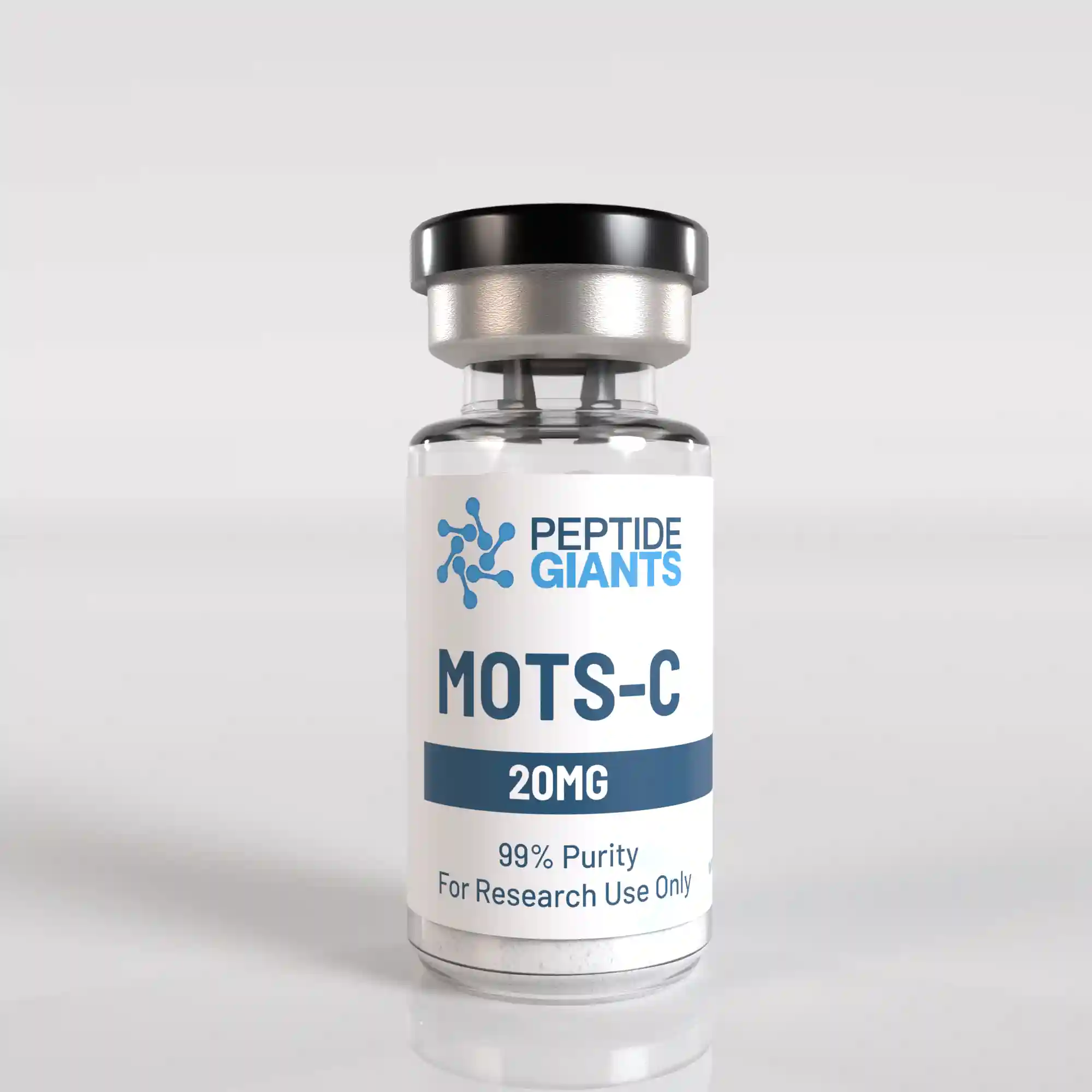
MOTS-C
MOTS-c is a 16-residue mitochondrial-encoded peptide, supplied as a lyophilized research peptide in 10 mg, 20 mg and 40 mg vials. Lab reports: 40mg lot PG-6015 at 99.24% ± 0.18% (Vanguard Laboratory), 20mg lot PG-2492 at 99.384% and 10mg lot PG-5198 at 98.739% (Janoshik Lab).
For laboratory research use only. Not for human or veterinary use.
Test results for this batch
Product details
Frequently asked questions
Store lyophilized vials at -20°C for maximum shelf life up to 24 months. Reconstituted solutions should be refrigerated at 2°C to 8°C and used within 30 days.
Every vial is printed with a batch lot number. You can check the HPLC purity certificate for that lot in the Test Results section above.
Orders placed before 6:00 PM ET, Monday to Friday, ship the same day from our Florida warehouse with full USPS / FedEx tracking.
Best sellers
About MOTS-C
MOTS-c (mitochondrial open reading frame of the 12S rRNA-c) is a 16-residue peptide encoded in the mitochondrial genome, supplied here as a lyophilized powder for laboratory research in 10 mg, 20 mg and 40 mg vials, with a batch-specific third-party lab report for each size.
You can browse every batch report on our lab reports page. Free shipping applies on 5 or more vials or orders over $200.
Specifications
| Compound name | MOTS-c (mitochondrial open reading frame of the 12S rRNA-c; UniProt: Mitochondrial-derived peptide MOTS-c)[2] |
|---|---|
| Sequence (16 residues) | Met-Arg-Trp-Gln-Glu-Met-Gly-Tyr-Ile-Phe-Tyr-Pro-Arg-Lys-Leu-Arg (MRWQEMGYIFYPRKLR)[2] |
| Gene | MT-RNR1 (mitochondrial 12S rRNA)[2] |
| Molecular formula | C101H152N28O22S2[3] |
| Molecular weight | About 2174.6 g/mol (PubChem value; not measured on the lab reports)[3] |
| CAS number | 1627580-64-6 (listed for this compound in PubChem)[3] |
| Form | Lyophilized powder |
| Sizes | 10 mg, 20 mg and 40 mg vials |
| Lot number (10mg) | PG-5198 |
| Purity (10mg batch) | 98.739% |
| Measured content (10mg batch) | 9.98 mg against 10 mg labeled |
| Testing laboratory (10mg) | Janoshik Lab (analysis conducted 10 June 2026) |
| Lot number (20mg) | PG-2492 |
| Purity (20mg batch) | 99.384% |
| Measured content (20mg batch) | 22.13 mg against 20 mg labeled |
| Testing laboratory (20mg) | Janoshik Lab (analysis conducted 22 January 2026) |
| Lot number (40mg) | PG-6015 |
| Purity (40mg batch) | 99.24% ± 0.18% by HPLC-UV/VIS |
| Measured content (40mg batch) | 41.53 mg against 40 mg labeled |
| Identity (40mg batch) | Reported as a pass, matches the reference standard (HPLC-UV/VIS) |
| Testing laboratory (40mg) | Vanguard Laboratory, Olympia, WA (report dated 7 August 2026) |
| Storage | −20 °C for the long term, protected from light and moisture |
| Intended use | Laboratory research use only. Not for human or veterinary use. |
The lab data above applies to the lots named. Check the lot number on your vial against the reports on our lab reports page.
Product details
Overview
MOTS-c is a short peptide of 16 amino acids with the sequence MRWQEMGYIFYPRKLR. UniProt lists it as a human mitochondrial-derived peptide encoded by the mitochondrial gene MT-RNR1.[2] It was reported in 2015 as a short open reading frame within the mitochondrial 12S rRNA, following the earlier identification of a similar mitochondrial open reading frame that encodes the peptide humanin.[1]
Published research
A 2018 study reported that MOTS-c, a peptide encoded in the mitochondrial genome, translocates to the nucleus following metabolic stress in cultured cells. In the nucleus it was reported to regulate a broad range of genes in response to glucose restriction and to interact with stress-responsive transcription factors such as NFE2L2 (NRF2).[4] UniProt records the interaction with the transcription factors ATF1 and NFE2L2.[2]
Purity and quality testing
Each size is tested as its own lot by an independent laboratory, and the result for each lot is published as the full report.
| Size | Lot | Laboratory | Report date | Purity | Measured vs labeled | Identity |
|---|---|---|---|---|---|---|
| 10mg | PG-5198 | Janoshik Lab | 10 Jun 2026 (analysis) | 98.739% | 9.98 mg vs 10 mg | Not reported |
| 20mg | PG-2492 | Janoshik Lab | 22 Jan 2026 (analysis) | 99.384% | 22.13 mg vs 20 mg | Not reported |
| 40mg | PG-6015 | Vanguard Laboratory | 7 Aug 2026 | 99.24% ± 0.18% (HPLC-UV/VIS) | 41.53 mg vs 40 mg | Reported pass vs reference standard |
What the Vanguard chromatogram shows (40mg)
The printed chromatogram for lot PG-6015, with detection at 214 nm, shows one dominant peak labeled MOTS-C at about 7.3 minutes (area 5823.54), a small peak at about 7.6 minutes (area 34.4012), and a small peak at about 7.1 minutes with no area printed. Using only the two printed areas gives about 99.41% (our calculation), a little above the reported 99.24%, so the printed numbers do not let us reproduce the reported figure exactly. The report does not state how purity was derived or define the ± 0.18%.
What the reports do not cover
The Janoshik reports for the 10mg and 20mg lots list only the measured amount and purity. They do not state an analytical method and have no chromatogram or identity result. The Vanguard report for the 40mg lot has an identity result against a reference standard, but it does not name the standard and has no mass spectrum. None of the reports covers net peptide content, counterion or water content, endotoxin, sterility or heavy metals. Measured quantities compared with the labeled amounts are: 10mg 0.2% below, 20mg about 10.7% above, and 40mg 3.8% above (our calculations). The Vanguard laboratory states that its results relate only to the sample it tested, that it did not take part in sample selection, and that it cannot confirm the authenticity of the sample or that it represents the whole lot.
How to read a lab report
- Check the lot number and report date. The lots shown here are PG-5198 (10mg), PG-2492 (20mg) and PG-6015 (40mg), and the lot should match your vial label.
- Find the purity and amount rows. The 40mg report also has an identity row and a chromatogram.
- Compare the measured quantity with the label for your vial size.
- Use the verification link on the lab reports page to confirm the report on the laboratory’s own site.
Form, preparation and storage
Why researchers order from Peptide Giants
Reliable work depends on knowing what is in the vial. A rounded “99%+” tells you little. We publish the batch result and the measured content instead.
Frequently asked questions about MOTS-c Lyophilized Research Peptide
What is MOTS-c?
MOTS-c (mitochondrial open reading frame of the 12S rRNA-c) is a 16-amino-acid peptide whose sequence is encoded within the mitochondrial 12S rRNA gene.[1][2] It is sold here as a lyophilized powder for laboratory research only.
What is the sequence?
Met-Arg-Trp-Gln-Glu-Met-Gly-Tyr-Ile-Phe-Tyr-Pro-Arg-Lys-Leu-Arg, written MRWQEMGYIFYPRKLR in single-letter code.[2]
Where does the sequence come from?
UniProt lists it as a human mitochondrial-derived peptide encoded by the mitochondrial gene MT-RNR1.[2] A 2015 paper reported it as a short open reading frame within the mitochondrial 12S rRNA.[1]
What are the formula, molecular weight and CAS number?
PubChem lists MOTS-c as C101H152N28O22S2 with a molecular weight of about 2174.6 g/mol and the CAS number 1627580-64-6.[3] Our own calculation from the sequence gives the same formula. The lab reports do not state a mass.
What do the published studies report?
A 2018 study reported that the peptide translocates to the nucleus after metabolic stress in cultured cells and interacts with stress-responsive transcription factors such as NFE2L2 (NRF2).[4] This page makes no claims about effects or uses.
Which sizes are sold?
10 mg, 20 mg and 40 mg vials. Each size comes from its own tested lot, and availability is shown in the size selector.
What purity is each size tested at?
Lot PG-5198 (10mg) tested at 98.739% and lot PG-2492 (20mg) at 99.384%, both at Janoshik Lab. Lot PG-6015 (40mg) tested at 99.24% ± 0.18% by HPLC-UV/VIS at Vanguard Laboratory, reported on 7 August 2026. The reports are on the lab reports page.
How does the measured content compare with the label?
The 10mg lot measured 9.98 mg against 10 mg, the 20mg lot 22.13 mg against 20 mg and the 40mg lot 41.53 mg against 40 mg. We publish the figures exactly as the laboratories reported them. If your work depends on an exact quantity, confirm it in your own assay.
Why is the 20mg measured content above the label?
The 20mg report lists 22.13 mg against 20 mg labeled, about 10.7% above (our calculation). The report does not say whether the quantity is expressed as net peptide or includes counterions and water.
Do the reports confirm identity?
Only the 40mg report has an identity row, reported as a pass against a reference standard by HPLC-UV/VIS. It does not name the standard and has no mass spectrum. The 10mg and 20mg reports have no identity result, so arrange your own identity testing if your work needs it.
How was the 40mg purity measured?
By HPLC-UV/VIS at 214 nm. Using the two printed peak areas, our calculation gives about 99.41%, a little above the reported 99.24%. The report does not state how the figure was derived.
Do the Janoshik reports state a method?
No. They list the measured amount and purity, and they have no chromatogram or identity result.
Does a report cover every vial?
No. The Vanguard report states that its results relate only to the sample it tested, that the laboratory did not take part in sample selection, and that it cannot confirm that the sample represents the whole lot. Match the lot on your vial to the reports on our lab reports page.
Can I see the lab reports before buying?
Yes. The reports are linked on this page, and every batch report is listed on our lab reports page.
References
- Lee C, Zeng J, Drew BG, et al. The mitochondrial-derived peptide MOTS-c promotes metabolic homeostasis and reduces obesity and insulin resistance. Cell Metab. 2015;21(3):443-54. PubMed
- UniProt Consortium. UniProtKB A0A0C5B5G6 (MOTSC_HUMAN), Mitochondrial-derived peptide MOTS-c, gene MT-RNR1, 16 amino acids. UniProt A0A0C5B5G6
- National Center for Biotechnology Information. PubChem Compound record CID 155885767, MOTS-c (human) (C101H152N28O22S2; CAS 1627580-64-6). PubChem 155885767
- Kim KH, Son JM, Benayoun BA, et al. The Mitochondrial-Encoded Peptide MOTS-c Translocates to the Nucleus to Regulate Nuclear Gene Expression in Response to Metabolic Stress. Cell Metab. 2018;28(3):516-524.e7. PubMed
Content last reviewed 28 November 2026. Formula and mass values are PubChem reference values and our calculations, not measurements from the lab reports.
Research background
Extensively researched across peer-reviewed literature for cellular mechanisms, binding affinity, and biochemical pathways in laboratory models.
Quality and analytical standard
Each batch is tested by Janoshik Lab, a third-party analytical lab. Check the lot number on your vial against the test results and COA on this page.
Customer reviews
Third time ordering. Lyophilized powder reconstitutes crystal clear with zero residue. Fast domestic shipping with tracking provided right away. You can trust Peptide Giants.
Dispatched the same afternoon from Tampa and arrived on my doorstep two days later. The insulated protective packaging ensured vials were completely intact.
Reached out on WhatsApp before buying to confirm batch expiry dates. Got a friendly response within 10 minutes. Research results have been spot-on.
No customs delays since it ships straight out of Florida. Clean cakes, sterile crimps, and rapid delivery every single time.