
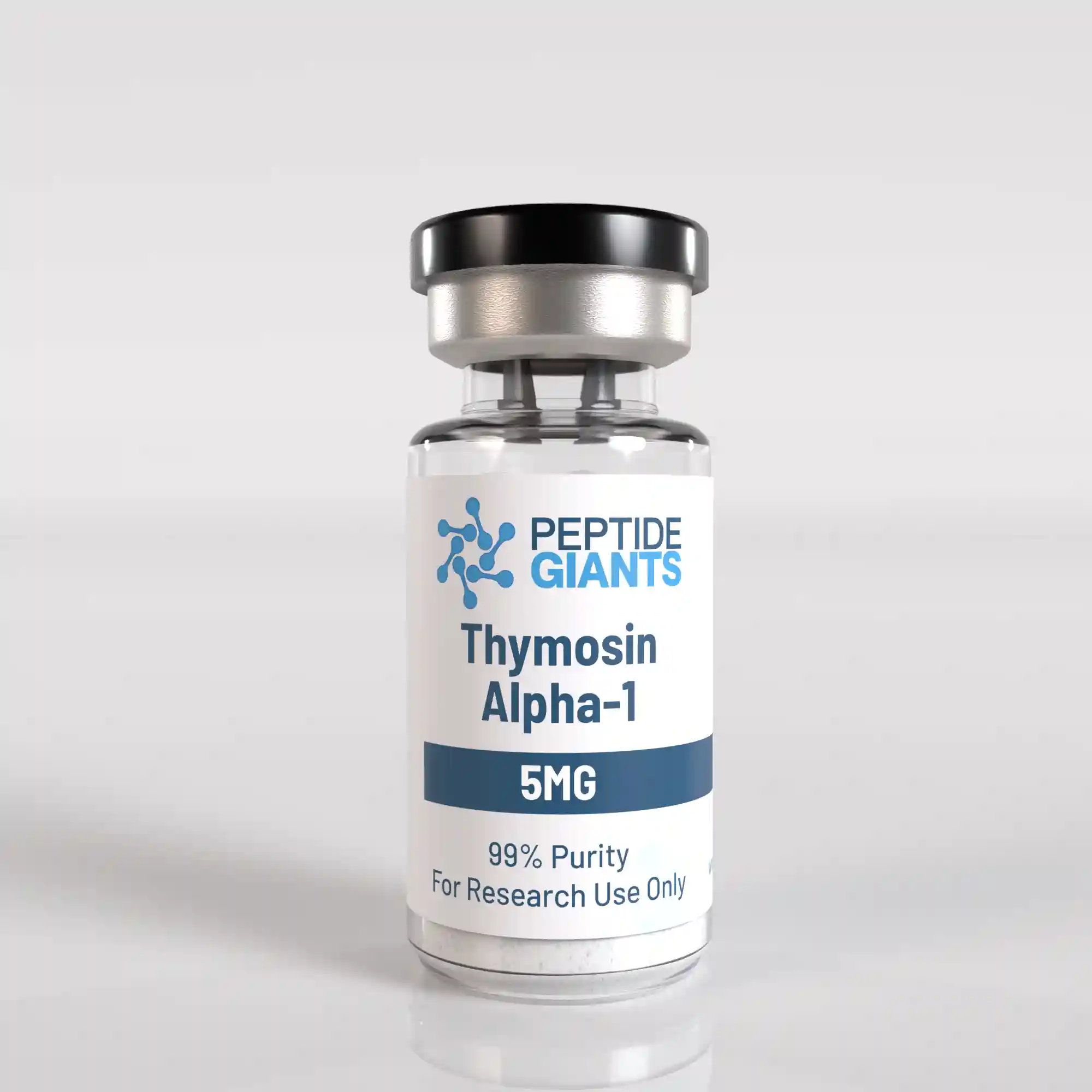
Thymosin Alpha-1
Thymosin Alpha-1 5mg and 10mg research peptide, a 28-residue acetylated peptide (Ac-SDAAVDTSSEITTKDLKEKKEVVEEAEN). Vanguard Laboratory reports: lot PG-4513 (10mg) 99.03% and lot PG-4512 (5mg) 99.01% purity. For laboratory research use only.
Test results for this batch
Product details
Frequently asked questions
Store lyophilized vials at -20°C for maximum shelf life up to 24 months. Reconstituted solutions should be refrigerated at 2°C to 8°C and used within 30 days.
Every vial is printed with a batch lot number. You can check the HPLC purity certificate for that lot in the Test Results section above.
Orders placed before 6:00 PM ET, Monday to Friday, ship the same day from our Florida warehouse with full USPS / FedEx tracking.
Best sellers
About Thymosin Alpha-1
Thymosin alpha 1 (also written Tα1) is a 28-residue peptide with an acetylated N-terminal serine. It corresponds to residues 2 to 29 of human prothymosin alpha.[1][2] We supply it as a lyophilized powder in 5mg and 10mg vials for laboratory research. Both sizes have a published third-party lab report from Vanguard Laboratory: lot PG-4513 (10mg) at 99.03% purity and lot PG-4512 (5mg) at 99.01% purity, each by HPLC-UV/VIS.
You can browse every batch report on our lab reports page. Free shipping applies on 5 or more vials or orders over $200.
Specifications
| Compound name | Thymosin alpha 1 (also written thymosin alpha1 or Tα1)[3] |
|---|---|
| Sequence | Ac-SDAAVDTSSEITTKDLKEKKEVVEEAEN (28 residues, N-terminal acetylserine)[2][1] |
| Source sequence | Residues 2 to 29 of human prothymosin alpha (UniProt P06454)[1] |
| Molecular formula | C129H215N33O55 (PubChem reference value, not measured on the lab reports)[3] |
| Molecular weight | About 3108.3 g/mol (PubChem reference value; not measured on the lab reports)[3] |
| Monoisotopic mass | 3106.504 Da (PubChem computed value; not measured on the lab reports)[3] |
| CAS number | 62304-98-7 (as listed in PubChem)[3] |
| Form and sizes | Lyophilized powder, 5mg and 10mg vials |
| Lot with published report (10mg) | PG-4513 |
| Purity (lot PG-4513) | 99.03% ± 0.18% (HPLC-UV/VIS) |
| Measured content (lot PG-4513) | 9.63 mg reported against the 10 mg label (96.3%, our calculation) |
| Lot with published report (5mg) | PG-4512 |
| Purity (lot PG-4512) | 99.01% ± 0.18% (HPLC-UV/VIS) |
| Measured content (lot PG-4512) | 5.20 mg reported against the 5 mg label (104.0%, our calculation) |
| Identity (both lots) | “Pass - Matches Ref. Standard”, method HPLC-UV/VIS |
| Report date | 28 July 2026 (both reports) |
| Testing laboratory | Vanguard Laboratory, Olympia, Washington |
The lab data above comes from the certificates of analysis for lots PG-4513 and PG-4512. Formula, mass and CAS values are PubChem reference values, and the percentages of the labeled amount are our calculation. None of them are measurements from the lab reports.
Product details
Overview
Thymosin alpha 1 was sequenced in 1979 from thymosin fraction 5, a thymus extract. The analysis described a highly acidic peptide with an isoelectric point of 4.2, made of 28 residues with acetylserine at the amino terminus.[2] In 1984 a polypeptide of about 112 residues was isolated from rat thymus and named prothymosin alpha. It carries the thymosin alpha 1 sequence at its amino terminus and was the major substance that reacted with a thymosin alpha 1 antiserum in the extracts studied.[4] UniProt now lists thymosin alpha-1 as residues 2 to 29 of human prothymosin alpha, a 111-residue protein.[1]
Thymosin alpha 1 is a different peptide from thymosin beta-4. UniProt lists human thymosin beta-4 as a 43-residue chain (residues 2 to 44) encoded by the gene TMSB4X.[5] Our TB-500 page covers the thymosin beta-4 compound.
Published research
Published laboratory work on thymosin alpha 1 includes the sequence and origin studies above. A cell-based study reported that thymosin alpha 1 induced maturation and interleukin-12 production in dendritic cells pulsed with the fungus Aspergillus fumigatus, through a p38 MAPK and NF-κB dependent pathway and signaling through the MyD88-dependent pathway involving Toll-like receptors.[6] The same paper also includes experiments in mice, which this page does not describe.
Purity and quality
Lot PG-4513 (10mg) and lot PG-4512 (5mg) were each tested by Vanguard Laboratory, an independent third-party laboratory in Olympia, Washington, and both reports are dated 28 July 2026. You can open the 10mg certificate of analysis and the 5mg certificate of analysis, both PDF files.
| Lot | Laboratory | Report date | Purity | Measured vs labeled | Identity |
|---|---|---|---|---|---|
| PG-4513 (10mg) | Vanguard Laboratory | 28 Jul 2026 | 99.03% ± 0.18% | 9.63 mg vs 10 mg | Pass, matches reference standard |
| PG-4512 (5mg) | Vanguard Laboratory | 28 Jul 2026 | 99.01% ± 0.18% | 5.20 mg vs 5 mg | Pass, matches reference standard |
What the reports show
Each report has a chromatogram and a three-row results table. Identity, chromatographic purity and quantity are all listed with HPLC-UV/VIS as the method, and identity reads “Pass - Matches Ref. Standard”. The 10mg report gives 99.03% ± 0.18% purity and 9.63 mg, which is 96.3% of the 10 mg label (our calculation). The 5mg report gives 99.01% ± 0.18% purity and 5.20 mg, which is 104.0% of the 5 mg label (our calculation). The chromatogram header lists a 214 nm signal. The reports do not comment on the difference between measured and labeled amounts.
What the reports do not cover
The reports do not name the reference standard or its source, and they include no mass spectrum, so identity rests on a chromatographic match rather than a mass measurement. They include no testing for heavy metals, endotoxin, sterility or microbial contamination, and they do not say whether the amount is peptide content or total powder, or which salt form is present. Vanguard states that its results relate only to the portion of the sample tested, that it did not take part in sample selection, and that it cannot confirm the authenticity of the sample or how well it represents the lot. The reports carry an ISO/IEC 17025:2017 accredited laboratory mark and refer readers to A2LA certificate 6377.01.01 for the list of accredited tests. They do not say which of the three results fall inside that scope.
How to read a lab report
- Check that the lot number on the report matches the lot on your vial.
- Find the identity result, the method and the chromatogram, and note whether a reference standard or a mass spectrum is named.
- Compare the measured amount with the labeled amount. Here that is 9.63 mg against 10 mg and 5.20 mg against 5 mg.
- Read the laboratory name and the report date, and use the lab’s own verification page if it offers one.
Form and preparation
Why researchers order from Peptide Giants
Reliable work depends on knowing what is in the vial. A rounded “99%+” tells you little. We publish the batch result and the measured content instead.
Frequently asked questions about Thymosin Alpha-1 Lyophilized Research Peptide
What is thymosin alpha 1?
Thymosin alpha 1 is a 28-residue peptide with an acetylated N-terminal serine, corresponding to residues 2 to 29 of human prothymosin alpha.[1][2] It is sold here as a lyophilized powder for laboratory research in 5mg and 10mg vials.
What is the amino acid sequence of thymosin alpha 1?
In one-letter code the sequence is SDAAVDTSSEITTKDLKEKKEVVEEAEN, with an acetyl group on the N-terminal serine.[2][1]
Which protein does thymosin alpha 1 come from?
UniProt lists thymosin alpha-1 as residues 2 to 29 of human prothymosin alpha, a 111-residue protein.[1] A 1984 study of rat thymus extracts described prothymosin alpha as the major substance that reacted with a thymosin alpha 1 antiserum and as carrying the thymosin alpha 1 sequence at its amino terminus.[4]
Is thymosin alpha 1 the same as TB-500 or thymosin beta-4?
No. Thymosin beta-4 is a different peptide. UniProt lists human thymosin beta-4 as a 43-residue chain (residues 2 to 44) encoded by the gene TMSB4X,[5] while thymosin alpha 1 has 28 residues and comes from prothymosin alpha.[1] Our TB-500 page covers the thymosin beta-4 compound.
What are the molecular formula and molecular weight of thymosin alpha 1?
PubChem gives C129H215N33O55 and a molecular weight of 3108.3 g/mol, with a computed monoisotopic mass of 3106.504 Da.[3] These are reference values. They are not measurements from the lab reports.
What sizes of thymosin alpha 1 do you sell?
Thymosin alpha 1 is supplied as 5mg and 10mg lyophilized vials. Each size has a published lab report.
What purity was reported for the thymosin alpha-1 lots?
Vanguard Laboratory reported 99.03% ± 0.18% for lot PG-4513 (10mg) and 99.01% ± 0.18% for lot PG-4512 (5mg), both by HPLC-UV/VIS and both dated 28 July 2026.
How much thymosin alpha 1 was measured in each vial?
The 10mg report lists 9.63 mg, which is 96.3% of the label. The 5mg report lists 5.20 mg, which is 104.0% of the label (both percentages are our calculation). The reports do not say whether the figures refer to peptide content or to total powder.
Does the lab report confirm the identity of thymosin alpha 1?
Both reports list an identity result of “Pass - Matches Ref. Standard” by HPLC-UV/VIS. They do not name the reference standard and include no mass spectrum, so the identity result rests on a chromatographic match.
Who tested the thymosin alpha-1 lots?
Vanguard Laboratory, an independent third-party laboratory in Olympia, Washington. The laboratory IDs are V260721-8 002 (5mg) and V260721-8 003 (10mg), and both reports are dated 28 July 2026.
What kind of published research is cited on this page?
The papers listed below cover the sequence and origin of thymosin alpha 1 and one cell-based signaling study.[2][4][6] None of them tests a Peptide Giants product, and this page makes no claim about use or effects in people or animals.
Where can I see all of your lab reports?
Every published batch report is listed on our lab reports page.
Do you ship the same day?
Orders placed by 2:00 PM EST ship the same business day. Free shipping applies on 5 or more vials or orders over $200.
References
- The UniProt Consortium. UniProtKB entry P06454, Prothymosin alpha (human). UniProt P06454
- Low TL, Goldstein AL. The chemistry and biology of thymosin. II. Amino acid sequence analysis of thymosin alpha1 and polypeptide beta1. J Biol Chem. 1979;254(3):987-995. PubMed
- National Center for Biotechnology Information. PubChem Compound Summary for CID 16130571 (thymosin alpha 1, CAS 62304-98-7). PubChem 16130571
- Haritos AA, Goodall GJ, Horecker BL. Prothymosin alpha: isolation and properties of the major immunoreactive form of thymosin alpha 1 in rat thymus. Proc Natl Acad Sci U S A. 1984;81(4):1008-1011. PubMed
- The UniProt Consortium. UniProtKB entry P62328, Thymosin beta-4 (human). UniProt P62328
- Romani L, Bistoni F, Gaziano R, et al. Thymosin alpha 1 activates dendritic cells for antifungal Th1 resistance through toll-like receptor signaling. Blood. 2004;103(11):4232-4239. PubMed
Content last reviewed 29 November 2026. Formula and mass values are PubChem reference values and our calculations, not measurements from the lab reports.
Research background
Extensively researched across peer-reviewed literature for cellular mechanisms, binding affinity, and biochemical pathways in laboratory models.
Quality and analytical standard
Each batch is tested by Vanguard Laboratory, a third-party analytical lab. Check the lot number on your vial against the test results and COA on this page.
Customer reviews
Third time ordering. Lyophilized powder reconstitutes crystal clear with zero residue. Fast domestic shipping with tracking provided right away. You can trust Peptide Giants.
Dispatched the same afternoon from Tampa and arrived on my doorstep two days later. The insulated protective packaging ensured vials were completely intact.
Reached out on WhatsApp before buying to confirm batch expiry dates. Got a friendly response within 10 minutes. Research results have been spot-on.
No customs delays since it ships straight out of Florida. Clean cakes, sterile crimps, and rapid delivery every single time.