
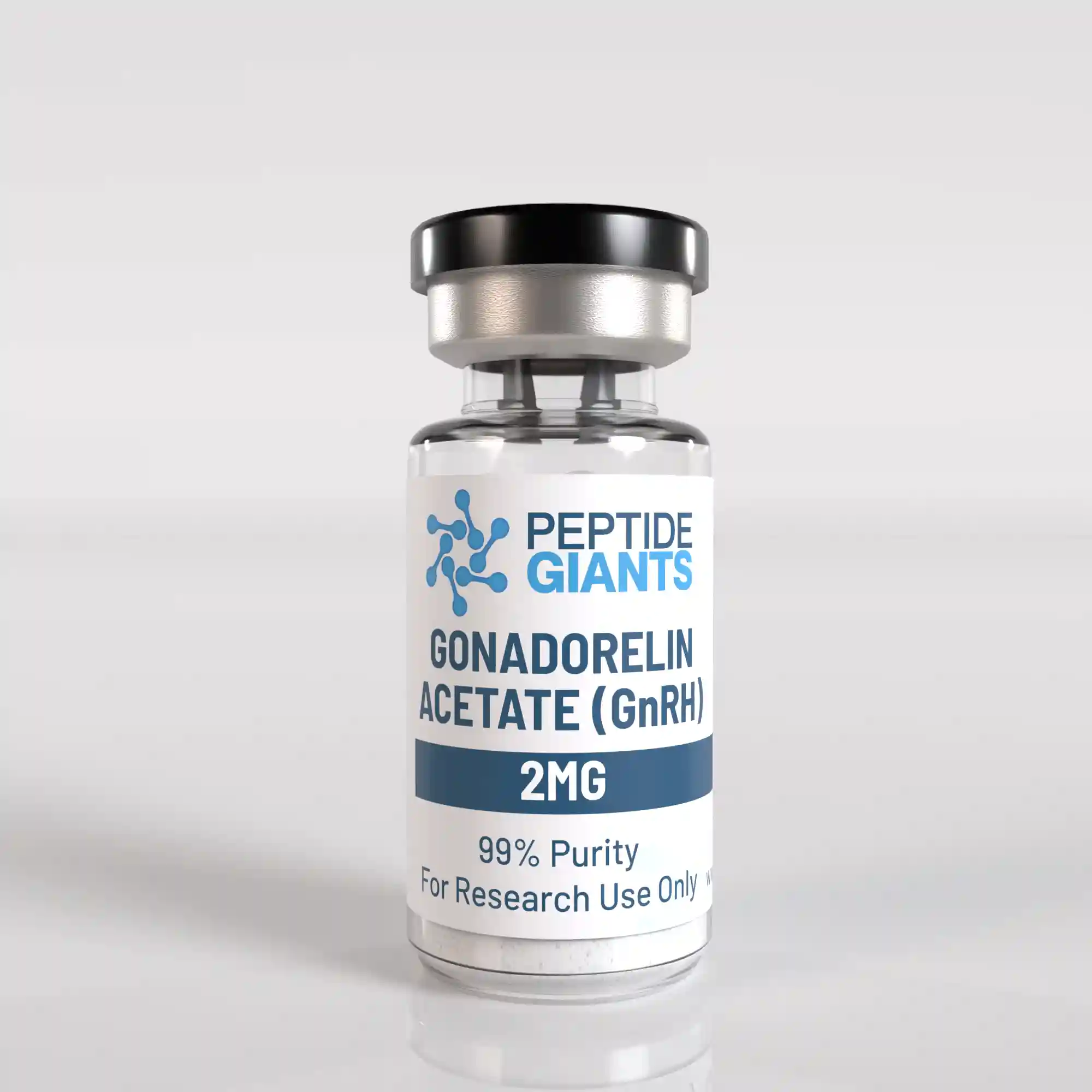
Gonadorelin Acetate (GnRH) 2mg
Gonadorelin acetate (GnRH) 2 mg lyophilized decapeptide for laboratory research use only. Lot PG-6004 was reported at 99.40% purity by Vanguard Laboratory on 1 Aug 2026.
Test results for this batch
Product details
Frequently asked questions
Store lyophilized vials at -20°C for maximum shelf life up to 24 months. Reconstituted solutions should be refrigerated at 2°C to 8°C and used within 30 days.
Every vial is printed with a batch lot number. You can check the HPLC purity certificate for that lot in the Test Results section above.
Orders placed before 6:00 PM ET, Monday to Friday, ship the same day from our Florida warehouse with full USPS / FedEx tracking.
Best sellers
About Gonadorelin Acetate (GnRH) 2mg
Gonadorelin acetate (GnRH) is the synthetic decapeptide pGlu-His-Trp-Ser-Tyr-Gly-Leu-Arg-Pro-Gly-NH2, supplied here as a lyophilized powder for laboratory research in a 2 mg vial, with a batch-specific third-party lab report.
You can browse every batch report on our lab reports page. Free shipping applies on 5 or more vials or orders over $200.
Specifications
| Compound name | Gonadorelin acetate (GnRH; also known as LH-releasing hormone, GnRH-I) |
|---|---|
| Sequence | pGlu-His-Trp-Ser-Tyr-Gly-Leu-Arg-Pro-Gly-NH2, 10 residues, with an N-terminal pyroglutamic acid and a C-terminal amide[2] |
| Molecular formula (free peptide) | C55H75N17O13 |
| Molecular weight (free peptide) | 1182.3 g/mol (PubChem reference value; our calculation gives the same) |
| Acetate form | C57H79N17O15, 1242.3 g/mol (PubChem reference value) |
| CAS number | 33515-09-2 (gonadorelin); 34973-08-5 (gonadorelin acetate) |
| Form | Lyophilized powder |
| Size | 2 mg vial |
| Published batch | PG-6004 |
| Purity | 99.40% ± 0.18% by HPLC-UV/VIS |
| Measured content | 2.38 mg against 2 mg labeled |
| Identity | Pass, matches the reference standard (HPLC-UV/VIS) |
| Testing laboratory | Vanguard Laboratory, report dated 1 August 2026 |
| Storage | −20 °C for the long term, protected from light and moisture |
| Intended use | Laboratory research use only. Not for human or veterinary use. |
The lab data above applies to lot PG-6004. Check the lot number on your vial against the reports on our lab reports page.
Product details
Overview
Gonadorelin is a decapeptide. PubChem lists the free peptide as C55H75N17O13 (1182.3 g/mol) and the acetate form as C57H79N17O15 (1242.3 g/mol).[2] Our own calculation from the sequence gives the same formula and weight for the free peptide.
How the sequence was established
In 1971 the sequence of porcine LH- and FSH-releasing hormone was proposed,[3] and in 1972 the primary structure of the ovine hypothalamic luteinizing hormone-releasing factor was established as pGlu-His-Trp-Ser-Tyr-Gly-Leu-Arg-Pro-Gly-NH2 by enzymatic degradation, Edman-dansylation sequencing and mass spectrometry. A decapeptide with that structure, prepared by total synthesis, gave the same sequencing result and had the same biological activities as the native factor, and the ovine sequence was identical to the porcine one.[1]
Receptor biology
A 2004 review describes how, in humans, hypothalamic GnRH regulates gonadotropin secretion through the pituitary GnRH type I receptor, which couples mainly through G(q). It also reports that a second form, GnRH II, is present in higher vertebrates, and that twenty-three structural variants of GnRH have been identified in protochordates and vertebrates.[4]
Pulsatile and continuous exposure
A 1978 study in rhesus monkeys with hypothalamic lesions reported that constant infusion of GnRH failed to restore sustained gonadotropin secretion, whereas intermittent administration at the physiological pulse frequency re-established it. The authors attributed the difference to the pattern of delivery rather than the amount of hormone, and reported that starting continuous administration in animals already restored by intermittent replacement could produce desensitization or down regulation.[5]
Purity and quality testing
Vanguard Laboratory tested lot PG-6004 and reported on 1 August 2026. The report lists identity, chromatographic purity and quantity, all by HPLC-UV/VIS.
| Test | Method | Result |
|---|---|---|
| Identity | HPLC-UV/VIS | Pass, matches the reference standard |
| Chromatographic purity | HPLC-UV/VIS | 99.40% ± 0.18% |
| Quantity | HPLC-UV/VIS | 2.38 mg |
The report carries the laboratory’s ISO/IEC 17025:2017 accreditation mark and refers to an A2LA certificate for its list of accredited tests.
What the chromatogram shows
The printed chromatogram, with detection at 214 nm, shows one dominant peak at about 6.8 minutes, labeled gonadorelin, with an area of 6644.88, and one small labeled peak at about 7.1 minutes with an area of 40.39. The main peak is 99.4% of the total of those two labeled areas (our calculation), which is consistent with the reported 99.40%. The report does not define the ± 0.18% value.
What the report does not cover
The report has no mass spectrum, so identity rests on an HPLC comparison with a reference standard. It does not report net peptide content, counterion or water content, endotoxin, sterility or heavy metals. The measured quantity of 2.38 mg is 19.0% above the labeled 2 mg (our calculation), and the report does not say what form the quantity is expressed in or why the two differ. Anyone who needs an exact amount should confirm it in their own assay. The laboratory also states that it did not take part in sample selection and cannot confirm that the sample represents the whole lot.
How to read this lab report
- Check the lot number and report date. They should read PG-6004 and 8/1/2026, and the lot should match your vial label.
- Find the identity row. It reads “Pass - Matches Ref. Standard” by HPLC-UV/VIS, which is a comparison with a reference standard and not a mass-spectrometry confirmation.
- Look at the chromatogram. One labeled gonadorelin peak should dominate, with only a small peak beside it.
- Read the purity row: 99.40% ± 0.18%. The report does not define the ± value.
- Read the quantity row: 2.38 mg against 2 mg labeled, and note the difference.
Form, preparation and storage
Why researchers order from Peptide Giants
Reliable work depends on knowing what is in the vial. A rounded “99%+” tells you little. We publish the batch result and the measured content instead.
Frequently asked questions about Gonadorelin Acetate (GnRH) Lyophilized Research Peptide
What is gonadorelin?
Gonadorelin is a synthetic decapeptide with the sequence pGlu-His-Trp-Ser-Tyr-Gly-Leu-Arg-Pro-Gly-NH2.[1] The product is sold as a lyophilized powder for laboratory research only.
Is gonadorelin the same as GnRH?
The sequence of the native hypothalamic factor, called GnRH, LRF or LH-RH in the literature, was established as the same decapeptide, and a synthetic decapeptide with that structure had the same biological activities in the original characterization.[1] PubChem also lists GnRH-I and LH-releasing factor among the names for gonadorelin.[2]
What is the difference between gonadorelin and gonadorelin acetate?
Gonadorelin is the peptide itself, C55H75N17O13 at 1182.3 g/mol. Gonadorelin acetate is its acetate salt, listed by PubChem as C57H79N17O15 at 1242.3 g/mol.[2] The acetate form is about 5.1% heavier than the free peptide, and the lab report does not say which basis its quantity uses.
What are the sequence, formula and molecular weight?
The sequence is pGlu-His-Trp-Ser-Tyr-Gly-Leu-Arg-Pro-Gly-NH2, with an N-terminal pyroglutamic acid and a C-terminal amide. For the free peptide PubChem lists C55H75N17O13, 1182.3 g/mol, CAS 33515-09-2.[2] Our calculation gives the same formula and weight. The lab report does not state a mass.
What does the lab report show?
For lot PG-6004, Vanguard Laboratory reported identity as a pass against the reference standard, chromatographic purity of 99.40% ± 0.18%, and a quantity of 2.38 mg, all by HPLC-UV/VIS. The report is dated 1 August 2026.
Why is the measured content above the label?
The measured 2.38 mg is 19.0% above the labeled 2 mg (our calculation). The report does not say whether the quantity is expressed as net peptide, as the acetate salt, or including water, and it does not explain the difference. Confirm the amount in your own assay if you need an exact figure.
Which lot does the report cover?
The report on this page is for lot PG-6004. Match the lot number on your vial to the reports on our lab reports page.
How is identity confirmed?
The report lists identity as “Pass - Matches Ref. Standard” by HPLC-UV/VIS. The report has no mass spectrum, so the identity result rests on comparison with a reference standard.
What does the chromatogram show?
At 214 nm there is one dominant peak at about 6.8 minutes, labeled gonadorelin, and one small labeled peak at about 7.1 minutes. The main peak is 99.4% of the total labeled area by our calculation, consistent with the reported 99.40%.
How was the structure of GnRH established?
The porcine sequence was proposed in 1971,[3] and the ovine factor was then shown to have the same pGlu-His-Trp-Ser-Tyr-Gly-Leu-Arg-Pro-Gly-NH2 structure by sequencing and mass spectrometry, with a synthetic decapeptide matching it.[1]
What does the receptor literature describe?
A 2004 review describes the pituitary GnRH type I receptor, which couples mainly through G(q) in humans, and a second form of GnRH, GnRH II, found in higher vertebrates.[4]
What is the difference between pulsatile and continuous exposure in the literature?
A 1978 monkey study reported that constant infusion of GnRH did not restore sustained gonadotropin secretion in animals with hypothalamic lesions, while intermittent administration at the physiological pulse frequency did, and that continuous administration could cause desensitization.[5] This is animal research, and we give no protocol or dosing information.
Can I see the lab report before buying?
Yes. The report is linked on this page, and every batch report is listed on our lab reports page.
Does the report cover every vial?
No. The laboratory states that its results relate only to the sample it tested, that it did not take part in sample selection, and that it cannot confirm that the sample represents the whole lot.
References
- Burgus R, Butcher M, Amoss M, Ling N, et al. Primary structure of the ovine hypothalamic luteinizing hormone-releasing factor (LRF). Proc Natl Acad Sci U S A. 1972;69(1):278-282. PubMed | Free full text (PMC)
- National Center for Biotechnology Information. PubChem Compound Summaries for Gonadorelin (CID 638793, CAS 33515-09-2) and Gonadorelin Acetate (CID 11980076). PubChem 638793 | PubChem 11980076
- Matsuo H, Baba Y, Nair RM, Arimura A, et al. Structure of the porcine LH- and FSH-releasing hormone. I. The proposed amino acid sequence. Biochem Biophys Res Commun. 1971;43(6):1334-1339. PubMed
- Millar RP, Lu ZL, Pawson AJ, Flanagan CA, et al. Gonadotropin-releasing hormone receptors. Endocr Rev. 2004;25(2):235-275. PubMed
- Belchetz PE, Plant TM, Nakai Y, Keogh EJ, et al. Hypophysial responses to continuous and intermittent delivery of hypopthalamic gonadotropin-releasing hormone. Science. 1978;202(4368):631-633. PubMed
Content last reviewed 27 November 2026. Formula and mass values on this page are PubChem reference values or our calculations, not measurements from the lab report.
Research background
Extensively researched across peer-reviewed literature for cellular mechanisms, binding affinity, and biochemical pathways in laboratory models.
Quality and analytical standard
Each batch is tested by Vanguard Laboratory, a third-party analytical lab. Check the lot number on your vial against the test results and COA on this page.
Customer reviews
Third time ordering. Lyophilized powder reconstitutes crystal clear with zero residue. Fast domestic shipping with tracking provided right away. You can trust Peptide Giants.
Dispatched the same afternoon from Tampa and arrived on my doorstep two days later. The insulated protective packaging ensured vials were completely intact.
Reached out on WhatsApp before buying to confirm batch expiry dates. Got a friendly response within 10 minutes. Research results have been spot-on.
No customs delays since it ships straight out of Florida. Clean cakes, sterile crimps, and rapid delivery every single time.