

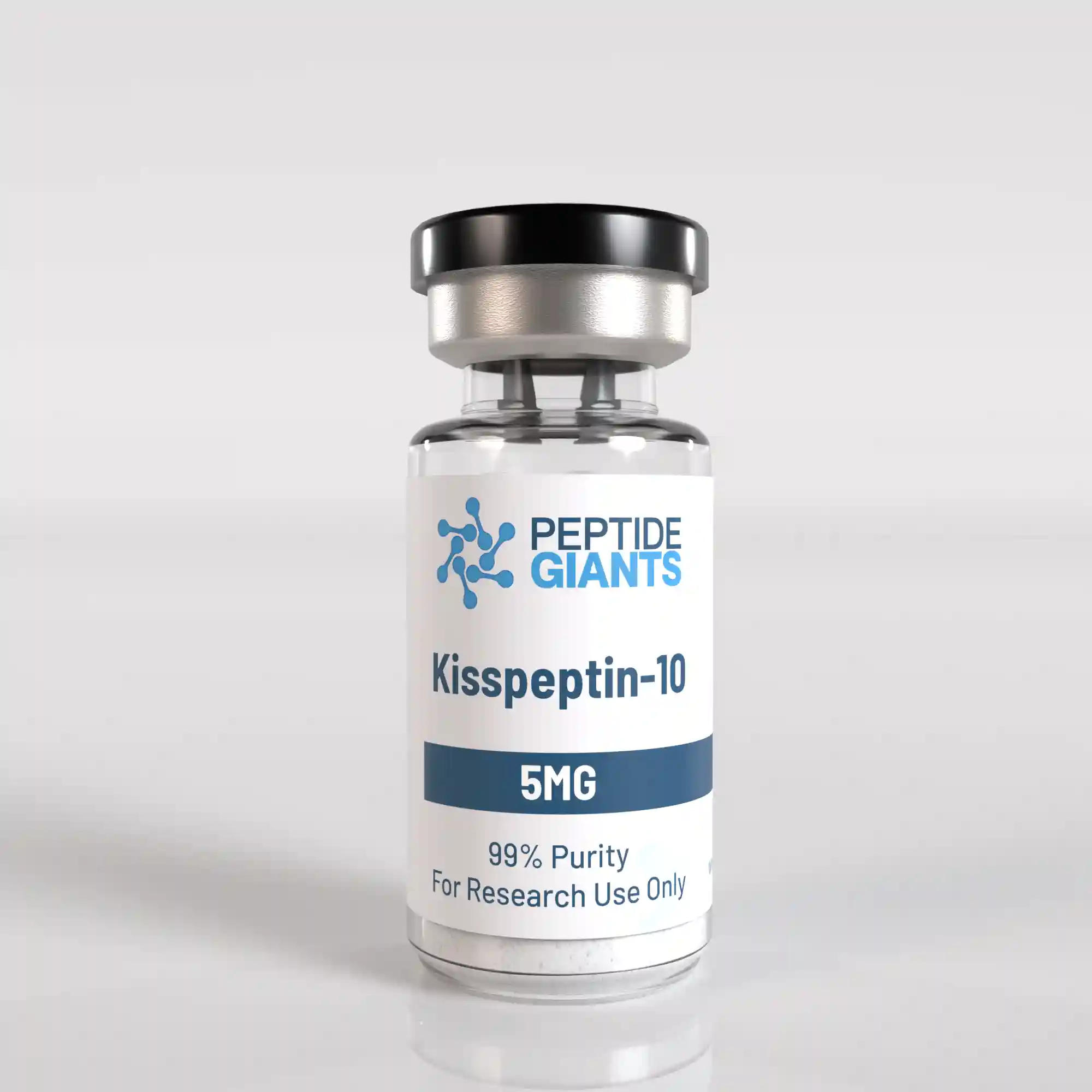
Kisspeptin-10 – Lyophilized Research Vial
Kisspeptin-10 (Kp-10, human sequence YNWNSFGLRF-NH2) is supplied as a lyophilized powder in 5 mg and 10 mg vials for laboratory research use only. Vanguard Laboratory reports are published for three lots: 97.32% to 98.60% chromatographic purity by HPLC-UV/VIS. The reports have no identity test. Not for human or veterinary use.
Test results for this batch
Product details
Frequently asked questions
Store lyophilized vials at -20°C for maximum shelf life up to 24 months. Reconstituted solutions should be refrigerated at 2°C to 8°C and used within 30 days.
Every vial is printed with a batch lot number. You can check the HPLC purity certificate for that lot in the Test Results section above.
Orders placed before 6:00 PM ET, Monday to Friday, ship the same day from our Florida warehouse with full USPS / FedEx tracking.
Best sellers
About Kisspeptin-10 – Lyophilized Research Vial
Kisspeptin-10 (Kp-10) is a 10-amino-acid, C-terminally amidated peptide, residues 112 to 121 of the human KISS1 precursor, supplied here as a lyophilized powder for laboratory research in 5 mg and 10 mg vials, with batch-specific third-party lab reports.
You can browse every batch report on our lab reports page. Free shipping applies on 5 or more vials or orders over $200.
Specifications
| Compound name | Kisspeptin-10 (Kp-10); also listed as Metastin (45-54), human[4] |
|---|---|
| Sequence (one-letter) | YNWNSFGLRF-NH2 (human), residues 112 to 121 of the KISS1 precursor[3] |
| Sequence (three-letter) | Tyr-Asn-Trp-Asn-Ser-Phe-Gly-Leu-Arg-Phe-NH2 |
| Molecular formula | C63H83N17O14[4] |
| Molecular weight | About 1302.4 g/mol (PubChem value; not measured on the lab reports)[4] |
| CAS number | 374675-21-5 (listed for this compound in PubChem)[4] |
| Form | Lyophilized powder |
| Sizes | 5 mg and 10 mg vials |
| Published lots | 10 mg: PG-6031 and PG-5191. 5 mg: PG-6018. |
| Purity | 97.32% to 98.60% across the three lots, by HPLC-UV/VIS (see lot table below) |
| Identity | Not reported on the lab reports we have read |
| Testing laboratory | Vanguard Laboratory |
| Storage | −20 °C for the long term, protected from light and moisture |
| Intended use | Laboratory research use only. Not for human or veterinary use. |
Each lot’s data applies to that lot only. Check the lot number on your vial against the reports on our lab reports page.
Product details
Overview
Kisspeptin-10 is a short, amidated peptide. UniProt lists it as residues 112 to 121 of the 138-residue human KISS1 precursor, within the longer 54-residue form (residues 68 to 121) and the 14- and 13-residue forms that share the same C-terminal end.[3] The kisspeptins described in 2001 share a C-terminal RF-amide motif,[1] which Kp-10 carries as Arg-Phe-NH2.
Human and rodent Kp-10 are not the same peptide
| Species | Residues (UniProt) | Sequence |
|---|---|---|
| Human | 112-121 | YNWNSFGLRF-NH2[3] |
| Rat and mouse | 110-119 | YNWNSFGLRY[5] |
The two differ at the last residue, Phe in human and Tyr in rat and mouse. This product is the human sequence. Listings that quote residues 110 to 119 describe the rodent form, so check the sequence before you compare products.
Published research
Natural kisspeptins of 54, 14 and 13 amino acids, all with a C-terminal RF-amide, were isolated from human placenta and described as ligands of the orphan receptor GPR54. They bound human and rat GPR54 in transfected cells with low nanomolar affinity, and the receptor was highly expressed in placenta, pituitary, pancreas and spinal cord.[1] A separate group cloned the human receptor, named AXOR12, which is 81% homologous to rat GPR54, and found KiSS-1-derived peptides to be high-potency agonists.[2]
Genetic studies linked the receptor to reproductive biology. Five affected siblings in a consanguineous family with isolated hypogonadotropic hypogonadism carried a homozygous 155-nucleotide deletion in GPR54, and the authors concluded that loss of function of GPR54 is a cause of the condition.[6] A second study in humans and mice found GPR54 mutations in affected patients, and Gpr54-deficient mice had isolated hypogonadotropic hypogonadism while still responding to exogenous gonadotropin-releasing hormone.[7]
In tumor cell models, Kp-10 activated GPR54 (coupled to Gαq) and blocked chemotaxis of CXCR4-expressing cells toward SDF-1/CXCL12 and inhibited the calcium mobilization that ligand induces.[8]
Purity and quality testing
Vanguard Laboratory has reported on three lots of this product. Each report lists chromatographic purity by HPLC-UV/VIS, and quantity where it could be measured. None has an identity row.
| Lot | Size | Reported | Purity | Quantity vs labeled |
|---|---|---|---|---|
| PG-6031 | 10 mg | 18 Nov 2026 | 98.60% | 9.35 mg (6.5% under, our calculation) |
| PG-5191 | 10 mg | 23 Jun 2026 | 98.24% ± 0.18% | 9.84 mg (1.6% under, our calculation) |
| PG-6018 | 5 mg | 7 Aug 2026 | 97.32% ± 0.18% | Below limit of quantification; estimated about 2 mg |
Values for PG-6031 are as listed on our lab reports page. The PG-5191 and PG-6018 certificates are linked there as PDFs and carry the laboratory’s ISO/IEC 17025:2017 accreditation mark and a reference to an A2LA certificate for its list of accredited tests.
What the chromatograms show
PG-5191 (10 mg). The chromatogram, with detection at 214 nm, shows one dominant peak labeled Kisspeptin 10 at about 7.0 minutes, a small peak near 1.4 minutes and a few small peaks between about 7.3 and 7.9 minutes. The report does not state how the 98.24% value was derived or define the ± 0.18%.
PG-6018 (5 mg). The chromatogram shows a peak labeled Kisspeptin at about 7.8 minutes (area 2084.83), several small peaks around it, and a much larger early peak at about 1.5 minutes (area 22620). The report does not say what the early peak is or whether it is included in the purity figure, so we do not recalculate the purity here.
The 5 mg quantity result
For lot PG-6018 the laboratory reported quantity as “Below Limit of Quantification” with an estimated quantity of about 2 mg against 5 mg labeled. That is an estimate, not a measured amount, and the report does not explain the shortfall. We show it as printed. Anyone who needs a defined amount from a 5 mg vial should confirm it in their own assay.
What the reports do not cover
The reports we have read have no identity test and no mass spectrum, so they do not on their own show that the main peak is Kisspeptin-10 rather than another peptide with a similar retention time. They also do not report net peptide content, counterion or water content, endotoxin, sterility or heavy metals. The laboratory states that its results relate only to the sample it tested, that it did not take part in sample selection, and that it cannot confirm that the sample represents the whole lot.
How to read these lab reports
- Check the lot number and report date, and match the lot to your vial label.
- Look for an identity row. These reports do not have one, so identity is not shown by the documents.
- Find the labeled main peak in the chromatogram, and note any other large peak.
- Read the purity row. The ± value, where given, is not defined on the report.
- Read the quantity row and compare it with the labeled amount. For PG-6018 it is an estimate below the limit of quantification.
Form, preparation and storage
Why researchers order from Peptide Giants
Reliable work depends on knowing what is in the vial. A rounded “99%+” tells you little. We publish the batch result and the measured content instead.
Frequently asked questions about Kisspeptin-10 Lyophilized Research Peptide
What is Kisspeptin-10?
Kisspeptin-10 (Kp-10) is a 10-amino-acid amidated peptide, residues 112 to 121 of the human KISS1 precursor.[3] It is sold here as a lyophilized powder for laboratory research only.
What is the sequence?
The human sequence is YNWNSFGLRF-NH2 (Tyr-Asn-Trp-Asn-Ser-Phe-Gly-Leu-Arg-Phe-NH2).[3]
Why do some listings show a different last residue?
Rat and mouse Kisspeptin-10 (residues 110 to 119) ends in Tyr, YNWNSFGLRY, while the human form ends in Phe.[3][5] Listings that quote 110 to 119 describe the rodent peptide. This product is the human sequence.
What are the formula, molecular weight and CAS number?
PubChem lists Kisspeptin-10 as C63H83N17O14 with a molecular weight of about 1302.4 g/mol and the CAS number 374675-21-5.[4] The lab reports do not state a mass.
What is Metastin (45-54)?
It is the same sequence under an older numbering. PubChem lists “Metastin (45-54)” among the synonyms for Kisspeptin-10.[4] UniProt now numbers the peptide 112 to 121 in the KISS1 precursor.[3]
How is Kisspeptin-10 related to the longer kisspeptins?
UniProt lists a 54-residue form (residues 68 to 121) and 14- and 13-residue forms (108 to 121 and 109 to 121) that end at the same C-terminal residue as Kp-10 (112 to 121).[3] All carry the C-terminal RF-amide.[1]
What receptor do kisspeptins act on?
Research describes GPR54 (also called KISS1R) as the receptor for the kisspeptins.[1][2] In one tumor-cell study, Kp-10 activated GPR54 coupled to Gαq.[8]
What do genetic studies say about GPR54?
A consanguineous family study found a homozygous GPR54 deletion in affected siblings with isolated hypogonadotropic hypogonadism.[6] A second study in patients and Gpr54-deficient mice reported GPR54 mutations in affected patients and isolated hypogonadotropic hypogonadism in the mice.[7]
What did the cell-signaling study report?
In tumor cell models, Kp-10 blocked chemotaxis toward SDF-1/CXCL12 in cells expressing CXCR4 and inhibited the calcium mobilization that ligand induces.[8] These are cell findings.
What do the 10 mg lab reports show?
Lot PG-5191 was reported on 23 June 2026 at 98.24% ± 0.18% purity and 9.84 mg quantity, both by HPLC-UV/VIS. Lot PG-6031, reported 18 November 2026, is listed at 98.60% purity and 9.35 mg on our lab reports page.
What does the 5 mg lab report show?
Lot PG-6018 was reported on 7 August 2026 at 97.32% ± 0.18% purity by HPLC-UV/VIS. Quantity was reported as below the limit of quantification, with an estimated quantity of about 2 mg against 5 mg labeled.
Why is the 5 mg quantity only an estimate?
The laboratory reported the amount as below its limit of quantification, so it gave an estimate rather than a measured value. The report does not explain the difference from the label, and we show the result as printed.
Do the lab reports confirm identity?
No. The reports we have read list purity and quantity only, with no identity row and no mass spectrum, so they do not on their own show which peptide the main peak is.
What is the large early peak on the 5 mg chromatogram?
The report shows a large peak at about 1.5 minutes (area 22620) and does not say what it is or whether it is part of the purity calculation. We do not interpret it beyond what is printed.
Why is the measured content below the label?
The 10 mg lots measured 9.84 mg and 9.35 mg, which is 1.6% and 6.5% under the label (our calculation). The reports do not say whether quantity is expressed as net peptide or includes counterions and water. Confirm the amount in your own assay if you need an exact figure.
Does a report cover every vial?
No. The laboratory states that its results relate only to the sample it tested, that it did not take part in sample selection, and that it cannot confirm that the sample represents the whole lot.
Can I see the lab reports before buying?
Yes. Every batch report is listed on our lab reports page.
References
- Kotani M, Detheux M, Vandenbogaerde A, et al. The metastasis suppressor gene KiSS-1 encodes kisspeptins, the natural ligands of the orphan G protein-coupled receptor GPR54. J Biol Chem. 2001;276(37):34631-34636. PubMed
- Muir AI, Chamberlain L, Elshourbagy NA, et al. AXOR12, a novel human G protein-coupled receptor, activated by the peptide KiSS-1. J Biol Chem. 2001;276(31):28969-28975. PubMed
- UniProt Consortium. UniProtKB Q15726 (KISS1_HUMAN), Metastasis-suppressor KiSS-1: Metastin 68-121, Kisspeptin-14 108-121, Kisspeptin-13 109-121, Kisspeptin-10 112-121, C-terminal amide. UniProt Q15726
- National Center for Biotechnology Information. PubChem Compound record CID 25240297, Kisspeptin-10 (C63H83N17O14; synonyms include Metastin (45-54) and CAS 374675-21-5). PubChem 25240297
- UniProt Consortium. UniProtKB Q7TSB7 (rat Kiss1) and Q6Y4S4 (mouse Kiss1), Kisspeptin-10 residues 110-119. UniProt Q7TSB7 and UniProt Q6Y4S4
- de Roux N, Genin E, Carel JC, et al. Hypogonadotropic hypogonadism due to loss of function of the KiSS1-derived peptide receptor GPR54. Proc Natl Acad Sci U S A. 2003;100(19):10972-10976. PubMed
- Seminara SB, Messager S, Chatzidaki EE, et al. The GPR54 gene as a regulator of puberty. N Engl J Med. 2003;349(17):1614-1627. PubMed
- Navenot JM, Wang Z, Chopin M, Fujii N, Peiper SC. Kisspeptin-10-induced signaling of GPR54 negatively regulates chemotactic responses mediated by CXCR4: a potential mechanism for the metastasis suppressor activity of kisspeptins. Cancer Res. 2005;65(22):10450-10456. PubMed
Content last reviewed 27 November 2026. Sequence numbering follows UniProt. Formula and mass values are PubChem reference values, not measurements from the lab reports.
Research background
Extensively researched across peer-reviewed literature for cellular mechanisms, binding affinity, and biochemical pathways in laboratory models.
Quality and analytical standard
Each batch is tested by Vanguard Laboratory, a third-party analytical lab. Check the lot number on your vial against the test results and COA on this page.
Customer reviews
Had a question about batch analysis and support responded within 15 minutes with the full analytical report. Extremely transparent and professional vendor. Best peptide supplier out there.
Checked the batch lot on the vial against the COA PDF download and everything lined up 100%. Reconstitution was instant with zero cloudiness. Outstanding analytical transparency.
Hit the bulk tier and the free Reconstitution Water was in the box just like the site showed. Very smooth checkout with instant tracking updates.
Switched from our previous vendor after seeing the third-party HPLC reports. Quality is superior and pricing with the volume tiers is unbeatable.