

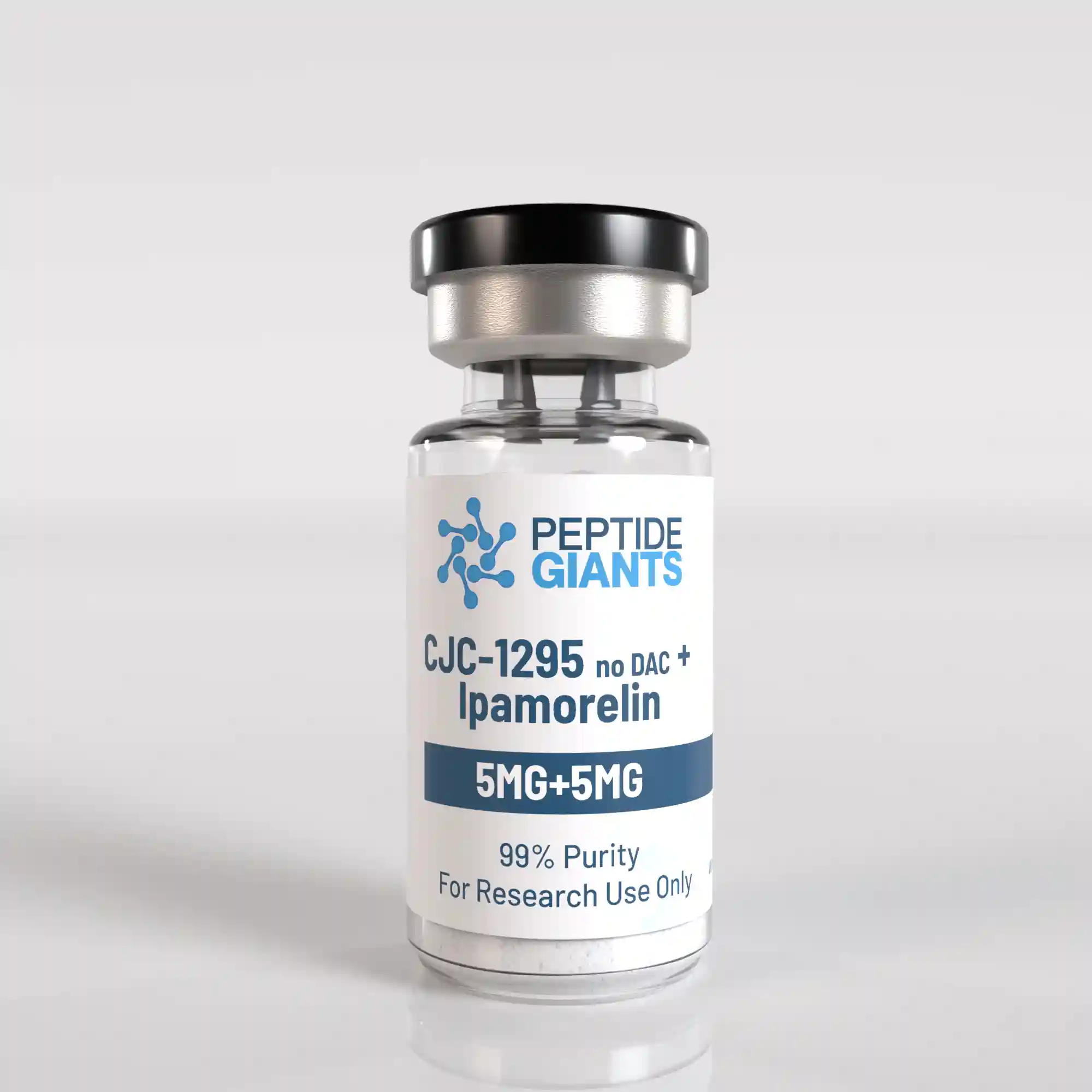
CJC1295 NO DAC 5mg+Ipamorelin 5mg
CJC-1295 (no DAC) 5 mg + Ipamorelin 5 mg blend, for laboratory research use only. Lot PG-6030 tested at 99.18% ± 0.18% purity by Vanguard Laboratory (13 Aug 2026).
Test results for this batch
Product details
Frequently asked questions
Store lyophilized vials at -20°C for maximum shelf life up to 24 months. Reconstituted solutions should be refrigerated at 2°C to 8°C and used within 30 days.
Every vial is printed with a batch lot number. You can check the HPLC purity certificate for that lot in the Test Results section above.
Orders placed before 6:00 PM ET, Monday to Friday, ship the same day from our Florida warehouse with full USPS / FedEx tracking.
Best sellers
About CJC1295 NO DAC 5mg+Ipamorelin 5mg
CJC-1295 (no DAC) + Ipamorelin is a research blend of two synthetic peptides in one lyophilized vial: CJC-1295 without a drug affinity complex, a 29-residue analog of growth hormone-releasing hormone (GHRH), and ipamorelin, a five-residue peptide of the growth hormone secretagogue class. Each vial is labeled 5 mg of each peptide and is supplied for laboratory research, with a batch-specific third-party lab report that measures both.
You can browse every batch report on our lab reports page. Free shipping applies on 5 or more vials or orders over $200.
Specifications
| Product name | CJC-1295 (no DAC) + Ipamorelin, 5 mg / 5 mg |
|---|---|
| Blend | Two peptides in one lyophilized vial, labeled 5 mg of each |
| Component 1 | CJC-1295 (no DAC), also called Modified GRF (1-29) |
| CJC-1295 sequence | Tyr-D-Ala-Asp-Ala-Ile-Phe-Thr-Gln-Ser-Tyr-Arg-Lys-Val-Leu-Ala-Gln-Leu-Ser-Ala-Arg-Lys-Leu-Leu-Gln-Asp-Ile-Leu-Ser-Arg-NH2 (29 residues)[1] |
| CJC-1295 formula and weight | C152H252N44O42, 3367.9 g/mol (PubChem reference value; our calculation from the sequence gives 3367.95). CAS 863288-34-0. |
| Component 2 | Ipamorelin (also coded NNC 26-0161) |
| Ipamorelin sequence | Aib-His-D-2-Nal-D-Phe-Lys-NH2 (5 residues)[2] |
| Ipamorelin formula and weight | C38H49N9O5, 711.9 g/mol (PubChem reference value[3]). CAS 170851-70-4. |
| Form | Lyophilized powder |
| Published batch | PG-6030 |
| Purity (this lot) | 99.18% ± 0.18% by HPLC-UV/VIS |
| Measured content | CJC-1295: 5.29 mg. Ipamorelin: 5.31 mg. Labeled 5 mg each. |
| Identity | Pass, matches the reference standard (HPLC-UV/VIS) |
| Testing laboratory | Vanguard Laboratory, report dated 13 August 2026 |
| Storage | Cool, dry, protected from light; −20 °C for the long term |
| Intended use | Laboratory research use only. Not for human or veterinary use. |
Product details
Overview
This product puts two peptides in a single vial instead of two. In the lab that means both are dissolved together, and the lab report analyzes the mixed sample, so one report gives identity, purity and quantity for each peptide. If your protocol needs one peptide at a time, we also list CJC-1295 No DAC and Ipamorelin separately.
CJC-1295 (no DAC)
CJC-1295 (no DAC) is a 29-residue peptide amide that follows the first 29 amino acids of growth hormone-releasing hormone, with four substitutions. Jetté et al. described CJC-1295 as a tetrasubstituted form of hGRF(1-29) with an extra lysine carrying a maleimidopropionamide group at the C terminus, which lets the peptide bond to the free thiol of serum albumin.[4] That group is what the “DAC” (drug affinity complex) in the name refers to. The product on this page does not have it. PubChem lists the 29-residue peptide as C152H252N44O42, 3367.9 g/mol,[1] and our own calculation from the sequence gives the same formula.
Native GHRH is cleaved in human plasma at its N terminus to a (3-44) product that has less than one thousandth of the activity of the intact hormone.[5] In the sequence on this page, position 2 is D-alanine where the native hormone has alanine.
Ipamorelin
Ipamorelin is a pentapeptide amide, Aib-His-D-2-Nal-D-Phe-Lys-NH2, built from three non-standard residues: 2-aminoisobutyric acid (Aib), D-2-naphthylalanine (D-2-Nal) and D-phenylalanine.[2] PubChem lists it as C38H49N9O5, 711.9 g/mol, CAS 170851-70-4.[3] In its original 1998 characterization, ipamorelin released growth hormone from primary rat pituitary cells with potency and efficacy similar to GHRP-6, and profiling with GHRP and GHRH antagonists indicated that it acts through a GHRP-like receptor.[2]
Two peptides, two receptors
GRF analogs act at the GRF receptor on anterior pituitary cells.[4] Growth hormone secretagogues act through a separate G protein-coupled receptor that Howard et al. cloned from pituitary and hypothalamus in 1996.[6] That receptor, GHS-R1a, is now called the ghrelin receptor because it responds to the peptide ghrelin.[7]
Purity and quality testing
Vanguard Laboratory tested lot PG-6030 and reported on 13 August 2026. The report lists identity, chromatographic purity and the quantity of each peptide, all by HPLC-UV/VIS.
| Test | Method | Result |
|---|---|---|
| Identity | HPLC-UV/VIS | Pass, matches the reference standard |
| Chromatographic purity | HPLC-UV/VIS | 99.18% ± 0.18% |
| Quantity: CJC-1295 | HPLC-UV/VIS | 5.29 mg |
| Quantity: ipamorelin | HPLC-UV/VIS | 5.31 mg |
The report carries the laboratory’s ISO/IEC 17025:2017 accreditation mark and refers to an A2LA certificate for its list of accredited tests.
What the chromatogram shows
The printed chromatogram, with detection at 214 nm, shows two main peaks labeled ipamorelin (about 5.7 minutes) and CJC-1295 (about 7.9 minutes), and a small unlabeled peak just after the ipamorelin peak, near 5.8 minutes. Using the peak areas printed on the chromatogram, we calculate that the two named peaks make up about 99.2% of the total integrated area, which agrees with the reported purity, and that the small peak accounts for most of the remaining 0.8%. This is our own arithmetic from the printed values, and the report does not state how purity is calculated or what the small peak is.
What the report does not cover
The report has no mass spectrum, so identity rests on an HPLC comparison with a reference standard. It does not report net peptide content, counterion or water content, endotoxin, sterility or heavy metals. The measured amounts are about 5.8% (CJC-1295) and 6.2% (ipamorelin) above the labeled 5 mg, and the report does not say what form the quantities are expressed in. The laboratory also states that it did not take part in sample selection and cannot confirm that the sample represents the whole lot.
How to read this lab report
- Check the lot number and report date. They should read PG-6030 and 8/13/2026, and the lot should match your vial label.
- Find the identity row. It reads “Pass - Matches Ref. Standard” by HPLC-UV/VIS, which is a comparison with a reference standard and not a mass-spectrometry confirmation.
- Look at the chromatogram. Two labeled main peaks should dominate, with one small unlabeled peak near 5.8 minutes.
- Read the purity row: 99.18% ± 0.18%. The report does not define the ± value.
- Read the two quantity rows: 5.29 mg for CJC-1295 and 5.31 mg for ipamorelin, against 5 mg labeled for each.
Form, preparation and storage
How the components compare
Both peptides in this blend, and the DAC form of CJC-1295, are listed below with their PubChem reference values.
| Compound | Residues | Formula | Weight | Notes |
|---|---|---|---|---|
| CJC-1295 (no DAC), in this blend | 29, C-terminal amide | C152H252N44O42 | 3367.9 g/mol | No albumin-binding lysine derivative[1] |
| CJC-1295 with DAC, not in this product | 29 plus one lysine derivative | C165H269N47O46 | 3647.2 g/mol | Adds a lysine with a maleimidopropionamide group that bonds to serum albumin[4][8] |
| Ipamorelin, in this blend | 5, C-terminal amide | C38H49N9O5 | 711.9 g/mol | Contains Aib, D-2-Nal and D-Phe[2][3] |
The formula difference between the DAC and no-DAC forms is C13H17N3O4, which equals one lysine residue plus a maleimidopropionyl group by our calculation.
Why researchers order from Peptide Giants
Reliable work depends on knowing what is in the vial. A rounded “99%+” tells you little. We publish the batch result and the measured content instead.
Frequently asked questions about CJC-1295 (no DAC) + Ipamorelin Lyophilized Research Peptide Blend
What is CJC-1295 (no DAC) + Ipamorelin?
It is a research blend of two synthetic peptides in one lyophilized vial, labeled 5 mg of each. CJC-1295 (no DAC) is a 29-residue analog of growth hormone-releasing hormone. Ipamorelin is a five-residue peptide of the growth hormone secretagogue class. The product is sold for laboratory research only.
What does “no DAC” mean?
DAC stands for drug affinity complex, a reactive lysine derivative added at the C terminus of CJC-1295 so that it can bond to serum albumin.[4] “No DAC” means the peptide on this page does not have that group. It is the 29-residue peptide only.
How does CJC-1295 with DAC differ chemically from the no-DAC form?
PubChem lists the DAC form as C165H269N47O46 (3647.2 g/mol)[8] and the no-DAC peptide as C152H252N44O42 (3367.9 g/mol).[1] The difference, C13H17N3O4, equals one lysine residue plus a maleimidopropionyl group by our calculation, which fits the lysine derivative that Jetté et al. describe.[4] This page covers the no-DAC form only.
What is ipamorelin?
Ipamorelin is a synthetic pentapeptide amide, Aib-His-D-2-Nal-D-Phe-Lys-NH2, developed as a growth hormone secretagogue. In its original 1998 characterization it released growth hormone from rat pituitary cells and in rats and swine, and it acted through a GHRP-like receptor.[2]
Which receptors do the two peptides act on?
In published work, GRF analogs such as CJC-1295 act at the GRF receptor on anterior pituitary cells.[4] Growth hormone secretagogues such as ipamorelin act through a separate G protein-coupled receptor, GHS-R1a, which was cloned in 1996[6] and is now called the ghrelin receptor.[7]
Why are the two peptides combined in one vial?
It is a formulation choice for researchers who want both compounds in one preparation. Because the peptides act through different receptors, some labs study how the pathways interact. We found no primary research study of this specific blend in PubMed, so this page makes no claim that the combination is additive or synergistic.
What do 5 mg / 5 mg mean?
The vial is labeled 5 mg of CJC-1295 (no DAC) and 5 mg of ipamorelin. The lab report for lot PG-6030 measured 5.29 mg and 5.31 mg.
What purity does the lab report show?
Lot PG-6030 tested at 99.18% ± 0.18% chromatographic purity by HPLC-UV/VIS at Vanguard Laboratory, reported on 13 August 2026. The report gives one purity value for the blend and does not define the ± value.
Why does the measured content differ from the label?
The measured amounts are about 5.8% (CJC-1295) and 6.2% (ipamorelin) above the labeled 5 mg. The report does not say whether the quantities are expressed as net peptide or include counterions and water.
How is identity confirmed?
The report lists identity as “Pass - Matches Ref. Standard” by HPLC-UV/VIS, and the chromatogram labels the ipamorelin and CJC-1295 peaks. The report has no mass spectrum, so the identity result rests on comparison with a reference standard.
What is the small peak on the chromatogram?
There is a small unlabeled peak just after the ipamorelin peak, near 5.8 minutes. By our arithmetic from the printed peak areas it is under 1% of the total area. The report does not identify it.
What are the molecular formulas and weights?
PubChem lists CJC-1295 (no DAC) as C152H252N44O42, 3367.9 g/mol,[1] and ipamorelin as C38H49N9O5, 711.9 g/mol.[3] Our calculations from the sequences give the same formulas. The lab report does not state masses.
Can I see the lab report before buying?
Yes. The report for lot PG-6030 is linked on this page, and every batch report is listed on our lab reports page.
Does the report cover every vial?
No. The laboratory states that its results relate only to the sample it tested, that it did not take part in sample selection, and that it cannot confirm that the sample represents the whole lot.
Has this blend been studied in people?
A PubMed title and abstract search for CJC-1295 together with ipamorelin returned 11 results on 27 November 2026, all review articles or an analytical method paper. We found no primary study of this specific blend, and we make no claims about its use or effects in people.
References
- National Center for Biotechnology Information. PubChem Compound Summary for CID 56841945 (CAS 863288-34-0), CJC-1295 without DAC. PubChem
- Raun K, Hansen BS, Johansen NL, et al. Ipamorelin, the first selective growth hormone secretagogue. Eur J Endocrinol. 1998;139(5):552-561. PubMed | DOI
- National Center for Biotechnology Information. PubChem Compound Summary for CID 9831659, Ipamorelin (CAS 170851-70-4). PubChem
- Jetté L, Léger R, Thibaudeau K, et al. Human growth hormone-releasing factor (hGRF)1-29-albumin bioconjugates activate the GRF receptor on the anterior pituitary in rats: identification of CJC-1295 as a long-lasting GRF analog. Endocrinology. 2005;146(7):3052-3058. PubMed | DOI
- Frohman LA, Downs TR, Williams TC, et al. Rapid enzymatic degradation of growth hormone-releasing hormone by plasma in vitro and in vivo to a biologically inactive product cleaved at the NH2 terminus. J Clin Invest. 1986;78(4):906-913. PubMed | DOI
- Howard AD, Feighner SD, Cully DF, et al. A receptor in pituitary and hypothalamus that functions in growth hormone release. Science. 1996;273(5277):974-977. PubMed | DOI
- Davenport AP, Bonner TI, Foord SM, et al. International Union of Pharmacology. LVI. Ghrelin receptor nomenclature, distribution, and function. Pharmacol Rev. 2005;57(4):541-546. PubMed | DOI
- National Center for Biotechnology Information. PubChem Compound Summary for CID 91971820, CJC-1295 with DAC. PubChem
Content last reviewed 27 November 2026. Formula and mass values on this page are PubChem reference values or our calculations, not measurements from the lab report.
Research background
Extensively researched across peer-reviewed literature for cellular mechanisms, binding affinity, and biochemical pathways in laboratory models.
Quality and analytical standard
Each batch is tested by Vanguard Laboratory, a third-party analytical lab. Check the lot number on your vial against the test results and COA on this page.
Customer reviews
Had a question about batch analysis and support responded within 15 minutes with the full analytical report. Extremely transparent and professional vendor. Best peptide supplier out there.
Checked the batch lot on the vial against the COA PDF download and everything lined up 100%. Reconstitution was instant with zero cloudiness. Outstanding analytical transparency.
Hit the bulk tier and the free Reconstitution Water was in the box just like the site showed. Very smooth checkout with instant tracking updates.
Switched from our previous vendor after seeing the third-party HPLC reports. Quality is superior and pricing with the volume tiers is unbeatable.