
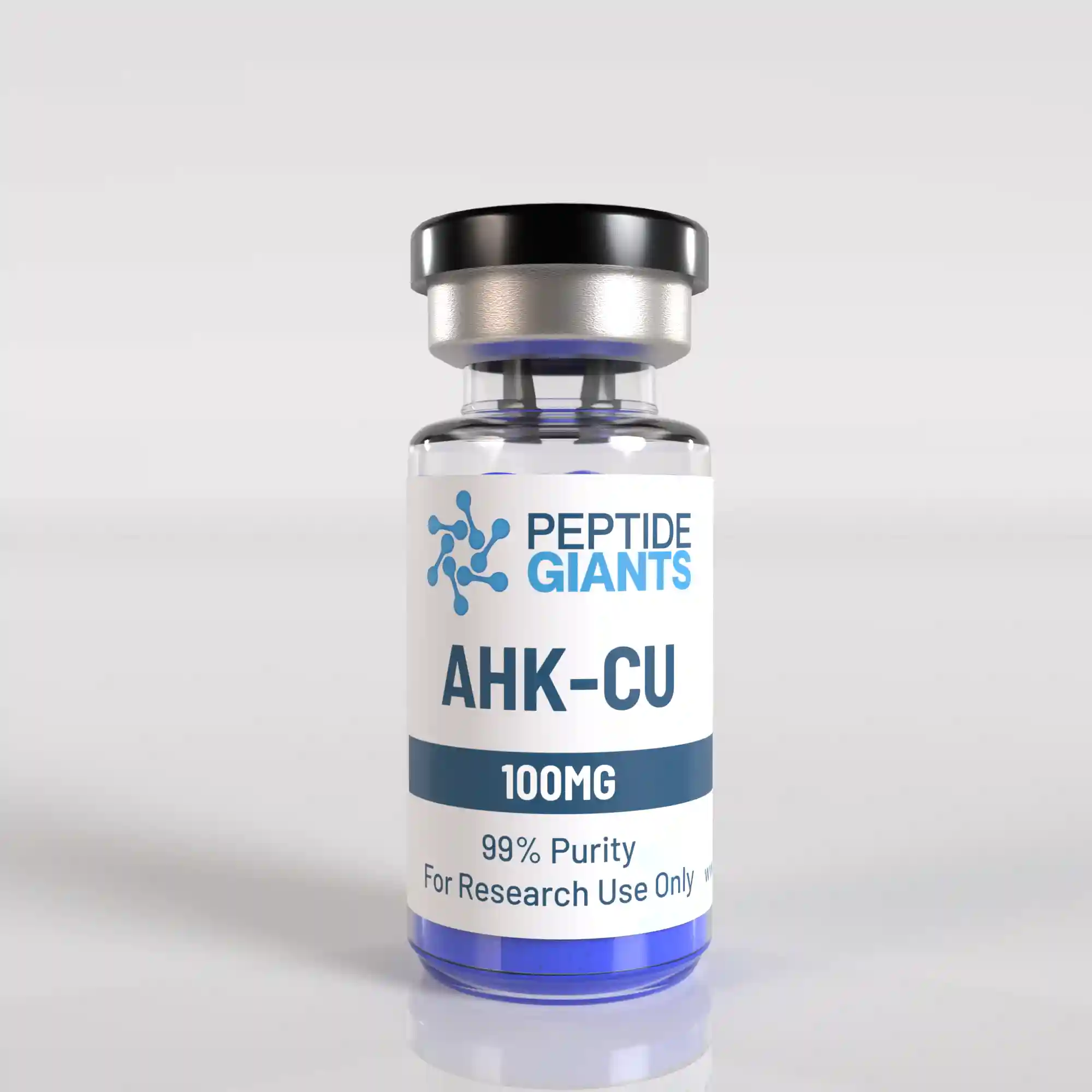
AHK-CU 100mg
AHK-Cu (copper tripeptide-3) 100mg for laboratory research use only. Batch PG-6014 tested at 99.05% purity by HPLC with identity and quantity reported by an independent third-party lab.
Test results for this batch
Product details
Frequently asked questions
Store lyophilized vials at -20°C for maximum shelf life up to 24 months. Reconstituted solutions should be refrigerated at 2°C to 8°C and used within 30 days.
Every vial is printed with a batch lot number. You can check the HPLC purity certificate for that lot in the Test Results section above.
Orders placed before 6:00 PM ET, Monday to Friday, ship the same day from our Florida warehouse with full USPS / FedEx tracking.
Best sellers
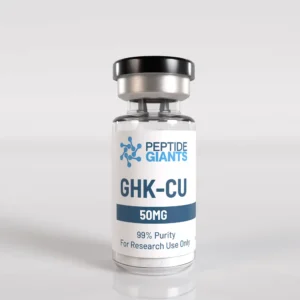
About AHK-CU 100mg
AHK-Cu (copper tripeptide-3) is a synthetic complex of the tripeptide alanyl-histidyl-lysine (Ala-His-Lys) with a copper(II) ion. It is a close structural relative of GHK-Cu, with alanine in place of glycine at the N-terminus. Batch PG-6014 of this 100 mg vial tested at 99.05% purity by HPLC-UV/VIS at an independent laboratory.
You can browse every batch report on our lab reports page. Free shipping applies on 5 or more vials or orders over $200.
Specifications
| Compound name | AHK-Cu (copper tripeptide-3) |
|---|---|
| Sequence | Ala-His-Lys, complexed with Cu(II) |
| Compound class | Copper-binding tripeptide complex |
| Molecular formula | C15H24CuN6O4, the value commonly published for the complex |
| Molecular weight | 415.93 g/mol, the value commonly published for the complex. The lab report does not state a mass, formula or salt form. |
| Free tripeptide (Ala-His-Lys) | C15H26N6O4, 354.41 g/mol[1] |
| Other PubChem reference values | CAS 767286-83-9 record: C15H23CuN6O4, 414.93 g/mol (one fewer hydrogen).[2] AHK-Cu entry: hydrochloride, C15H24ClCuN6O4, 451.39 g/mol.[3] |
| Salt form | Not stated on the lab report |
| CAS number | 767286-83-9[2] |
| Form | Lyophilized powder, 100 mg per vial |
| Published batch | PG-6014: 99.05% ± 0.18% purity by HPLC-UV/VIS |
| Measured content | 109.90 mg against 100 mg labeled (HPLC-UV/VIS) |
| Identity | Pass, matches the reference standard (HPLC-UV/VIS) |
| Testing laboratory | Vanguard Laboratory, independent third party |
| Storage | -20°C, away from light and moisture |
| Intended use | Laboratory research only |
Product details
Overview
AHK-Cu is a tripeptide made of alanine, histidine and lysine that binds a copper(II) ion. It is closely related to GHK-Cu (Gly-His-Lys-Cu), the better-known copper peptide, and differs from it by a single N-terminal residue. Researchers use AHK-Cu as a defined copper-peptide complex in cell-culture and tissue-biology work.
Chemistry
In a copper tripeptide complex the copper(II) ion is held by nitrogen donors of the peptide, which is why the compound is described as a complex and not simply as a peptide with a metal added. For the closely related GHK-Cu, structural studies show copper(II) bound by the N-terminal amine, a deprotonated backbone amide nitrogen and the histidine imidazole nitrogen, with a labile fourth site that is a carboxylate oxygen in the solid state.[4] We did not find a published structure of AHK-Cu itself, so its binding mode is inferred by analogy. The complex is commonly published as C15H24CuN6O4, 415.93 g/mol, which agrees, within rounding, with the free tripeptide (354.41 g/mol[1]) plus one copper ion minus two hydrogens by our calculation. Reference databases differ slightly because of protonation state: PubChem’s record for CAS 767286-83-9 lists C15H23CuN6O4 at 414.93 g/mol,[2] and its AHK-Cu entry is the hydrochloride salt, C15H24ClCuN6O4 at 451.39 g/mol.[3] The lab report does not state a mass, formula or salt form, so check which form your work requires.
Published research context
AHK-Cu has very little direct published research. A PubMed title and abstract search for AHK-Cu returns one paper, Pyo et al. (2007, Archives of Pharmacal Research). It evaluated L-alanyl-L-histidyl-L-lysine-Cu2+ on human hair follicles ex vivo and on cultured dermal papilla cells, at picomolar to nanomolar concentrations. AHK-Cu stimulated follicle elongation and dermal papilla cell proliferation. At the highest concentration it reduced the number of apoptotic cells, although that decrease was not statistically significant, and it raised the Bcl-2/Bax ratio and lowered cleaved caspase-3 and PARP. The authors proposed that the effect may come from stimulating proliferation and preventing apoptosis of dermal papilla cells.[5] Most of what is written about copper tripeptides comes from the older GHK-Cu literature, for example a 1988 report that GHK-Cu stimulated collagen synthesis in fibroblast cultures[6] and a 2018 review of that literature.[7] That work concerns GHK-Cu, not AHK-Cu. We found no clinical trial of AHK-Cu in PubMed.
Purity and quality testing
Every batch is tested by an independent third-party laboratory. The published report for this product is batch PG-6014 (100 mg), dated 7 August 2026, from Vanguard Laboratory. It lists identity (pass against the reference standard), chromatographic purity (99.05% ± 0.18%) and quantity (109.90 mg), all by HPLC-UV/VIS, with the chromatogram printed on the report. The report carries the laboratory’s ISO/IEC 17025:2017 accreditation mark and refers to an A2LA certificate for its list of accredited tests.
The measured quantity is about 9.9% above the labeled amount, and the report does not say whether it is expressed as the copper complex, the free peptide or a salt. The report has no mass spectrum or copper content assay, so it does not independently measure the copper. The laboratory also notes that it did not take part in sample selection and cannot confirm that the sample represents the whole lot.
How to read the lab report
- Check the batch number and report date. They should read PG-6014 and 8/7/2026, and the lot should match your vial label.
- Confirm the identity line reads pass against the reference standard.
- Read the purity result as chromatographic area percent. It reflects the peaks the detector sees and is not absolute mass purity.
- Compare the measured content with the labeled amount. This lot measured 109.90 mg against 100 mg labeled.
Form, preparation and storage
How AHK-Cu compares with GHK-Cu
Both are copper tripeptide complexes and they differ by one amino acid.
| Compound | Sequence | Notes |
|---|---|---|
| AHK-Cu (this product) | Ala-His-Lys + Cu(II) | Synthetic copper tripeptide. Limited direct published research. |
| GHK-Cu | Gly-His-Lys + Cu(II) | Naturally occurring GHK sequence, isolated from human plasma[6], with a much larger body of published research. |
The only structural difference is the N-terminal residue. Alanine has a methyl side chain where glycine has a hydrogen, which adds one CH2 unit, 14.03 g/mol.
Why researchers order from Peptide Giants
Reliable work depends on knowing what is in the vial. A rounded “99%+” tells you little. We publish the batch result and the measured content instead.
Frequently asked questions about AHK-Cu Lyophilized Research Peptide
What is AHK-Cu?
AHK-Cu, also called copper tripeptide-3, is a synthetic complex of the tripeptide alanyl-histidyl-lysine with a copper(II) ion. It is sold for laboratory research.
What does AHK stand for?
AHK is the one-letter code for the tripeptide alanyl-histidyl-lysine (Ala-His-Lys). The Cu means it is complexed with copper(II). Copper tripeptide-3 is another name for AHK-Cu.
What is the structure of the copper complex?
For the closely related GHK-Cu, structural studies show copper(II) bound by the N-terminal amine, a deprotonated backbone amide nitrogen and the histidine imidazole nitrogen, with a fourth site occupied by a labile carboxylate oxygen in the solid state.[4] We found no published structure of AHK-Cu itself, so its binding mode is inferred by analogy.
How is AHK-Cu different from GHK-Cu?
They differ by one amino acid. AHK-Cu has alanine at the N-terminus where GHK-Cu has glycine. GHK-Cu has a much larger body of published research, and we list it as a separate product. Alanine adds one methyl group, 14.03 g/mol, compared with glycine.
What is the molecular formula and weight?
The complex is commonly published as C15H24CuN6O4, about 415.93 g/mol, with CAS number 767286-83-9. Reference databases differ slightly: PubChem lists the CAS record at 414.93 g/mol (C15H23CuN6O4)[2] and its AHK-Cu entry as the hydrochloride salt at 451.39 g/mol.[3] The free tripeptide is C15H26N6O4, 354.41 g/mol.[1] The lab report does not state a mass, formula or salt form.
What did the 2007 AHK-Cu hair follicle study report?
Pyo et al. evaluated AHK-Cu on human hair follicles ex vivo and on cultured dermal papilla cells. It reported stimulated follicle elongation and dermal papilla cell proliferation at picomolar to nanomolar concentrations. At the highest concentration, apoptotic cells decreased without statistical significance, the Bcl-2/Bax ratio rose, and cleaved caspase-3 and PARP fell.[5] This is a laboratory study. It is not evidence of any effect in people.
Is AHK-Cu a cosmetic ingredient?
Copper peptides are discussed in cosmetic contexts elsewhere. The product sold here is a laboratory research chemical. It is not a cosmetic and is not sold for topical, cosmetic or any human use, and we give no concentration or formulation guidance.
What purity is it?
The current batch, PG-6014, tested at 99.05% ± 0.18% chromatographic purity by HPLC-UV/VIS at Vanguard Laboratory, with the report dated 7 August 2026.
Why does the measured content differ from the label?
The laboratory measures the amount in the vial by HPLC-UV/VIS and the result applies to that lot only. This lot measured 109.90 mg against 100 mg labeled. For exact concentrations, work from the measured value on the report and confirm the basis with your own method. That is about 9.9% above the labeled amount. The report does not say whether the quantity is expressed as the copper complex, the free peptide or a salt.
What does the identity test show?
The report lists identity as a pass against the reference standard by HPLC-UV/VIS. It does not include mass spectrometry or a copper content assay.
Do you provide a certificate of analysis?
Yes. The batch lab report (COA) is published on our lab reports page.
What does the certificate of analysis cover?
Each report covers one lot. This one shows identity, chromatographic purity and quantity by HPLC-UV/VIS with the chromatogram. It does not report heavy metals or microbiological testing.
Has AHK-Cu been studied in people?
A PubMed title and abstract search for AHK-Cu returns one paper, a 2007 study on human hair follicles ex vivo and cultured dermal papilla cells.[5] We found no clinical trial of AHK-Cu. We make no claims about its use or effects in people.
Does it need to be dissolved before use?
Yes. It is supplied as a lyophilized powder. Researchers usually test a small portion first and follow their own validated protocol. Confirm solubility and concentration for your own system.
References
- National Center for Biotechnology Information. PubChem Compound Summary for CID 7408502, L-Alanyl-L-histidyl-L-lysine. PubChem
- National Center for Biotechnology Information. PubChem Compound Summary for CID 178189140 (CAS 767286-83-9). PubChem
- National Center for Biotechnology Information. PubChem Compound Summary for CID 168431292 (AHK-Cu hydrochloride). PubChem
- Hureau C, Eury H, Guillot R, et al. X-ray and solution structures of Cu(II) GHK and Cu(II) DAHK complexes: influence on their redox properties. Chemistry. 2011;17(36):10151-10160. PubMed | DOI
- Pyo HK, Yoo HG, Won CH, et al. The effect of tripeptide-copper complex on human hair growth in vitro. Arch Pharm Res. 2007;30(7):834-839. PubMed | DOI
- Maquart FX, Pickart L, Laurent M, et al. Stimulation of collagen synthesis in fibroblast cultures by the tripeptide-copper complex glycyl-L-histidyl-L-lysine-Cu2+. FEBS Lett. 1988;238(2):343-346. PubMed | DOI
- Pickart L, Margolina A. Regenerative and protective actions of the GHK-Cu peptide in the light of the new gene data. Int J Mol Sci. 2018;19(7):1987. PubMed | DOI
Content last reviewed 27 November 2026. Formula and mass values on this page are published reference values or calculations, not measurements from the lab report.
Research background
Extensively researched across peer-reviewed literature for cellular mechanisms, binding affinity, and biochemical pathways in laboratory models.
Quality and analytical standard
Each batch is tested by Vanguard Laboratory, a third-party analytical lab. Check the lot number on your vial against the test results and COA on this page.
Customer reviews
Third time ordering. Lyophilized powder reconstitutes crystal clear with zero residue. Fast domestic shipping with tracking provided right away. You can trust Peptide Giants.
Dispatched the same afternoon from Tampa and arrived on my doorstep two days later. The insulated protective packaging ensured vials were completely intact.
Reached out on WhatsApp before buying to confirm batch expiry dates. Got a friendly response within 10 minutes. Research results have been spot-on.
No customs delays since it ships straight out of Florida. Clean cakes, sterile crimps, and rapid delivery every single time.